If the air conditioning (AC) cools poorly or has stopped, first check the symptoms: is the vent airflow normal, does it change when AC is on, and are there unpleasant smells or odd fan behaviour.
This helps narrow down the cause: from problems with moisture and contamination to leaks, control faults or component failures. When symptoms get worse, don't wait.
What to check immediately when AC cools poorly or stops working?
Before you drive to the garage, make a few simple observations. You do not need tools or to guess which parts are guilty — the aim is to organise the facts. Pay attention to what happens in the first minutes after switching on the AC and while driving.
If the airflow from the vents is weak regardless of AC, the issue may be in the air path or the vent control. When the airflow "feels the same" and only the cooling changes when AC is switched on, the refrigeration system or its controls are likely responsible. An unusual smell often indicates the system operates in conditions that encourage moisture and contamination.
- Is vent airflow similar to when AC is off (same strength and direction)?
- Does the engine behaviour change when AC is on (e.g. noticeable load, rpm fluctuations) or are other sounds heard?
- Do you smell a musty, damp odour or a burning smell from the vents?
- Is cooling uneven (for example, works for a while then weakens) or does it only appear after driving and the car has warmed up?
- Do the fans under the bonnet operate differently than usual, and do they return to normal once AC is switched off?
Poor cooling with a musty smell — what does that usually mean?
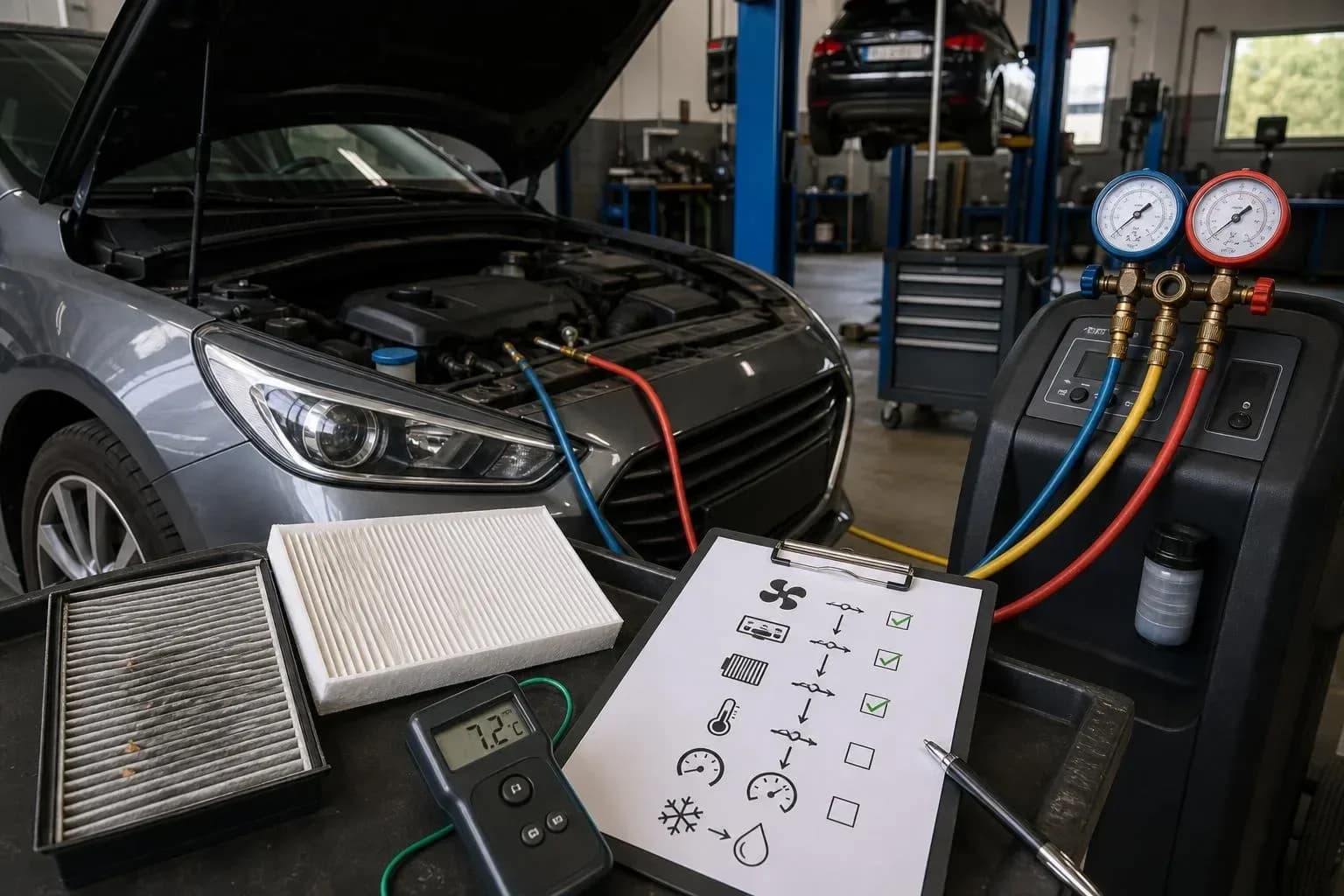
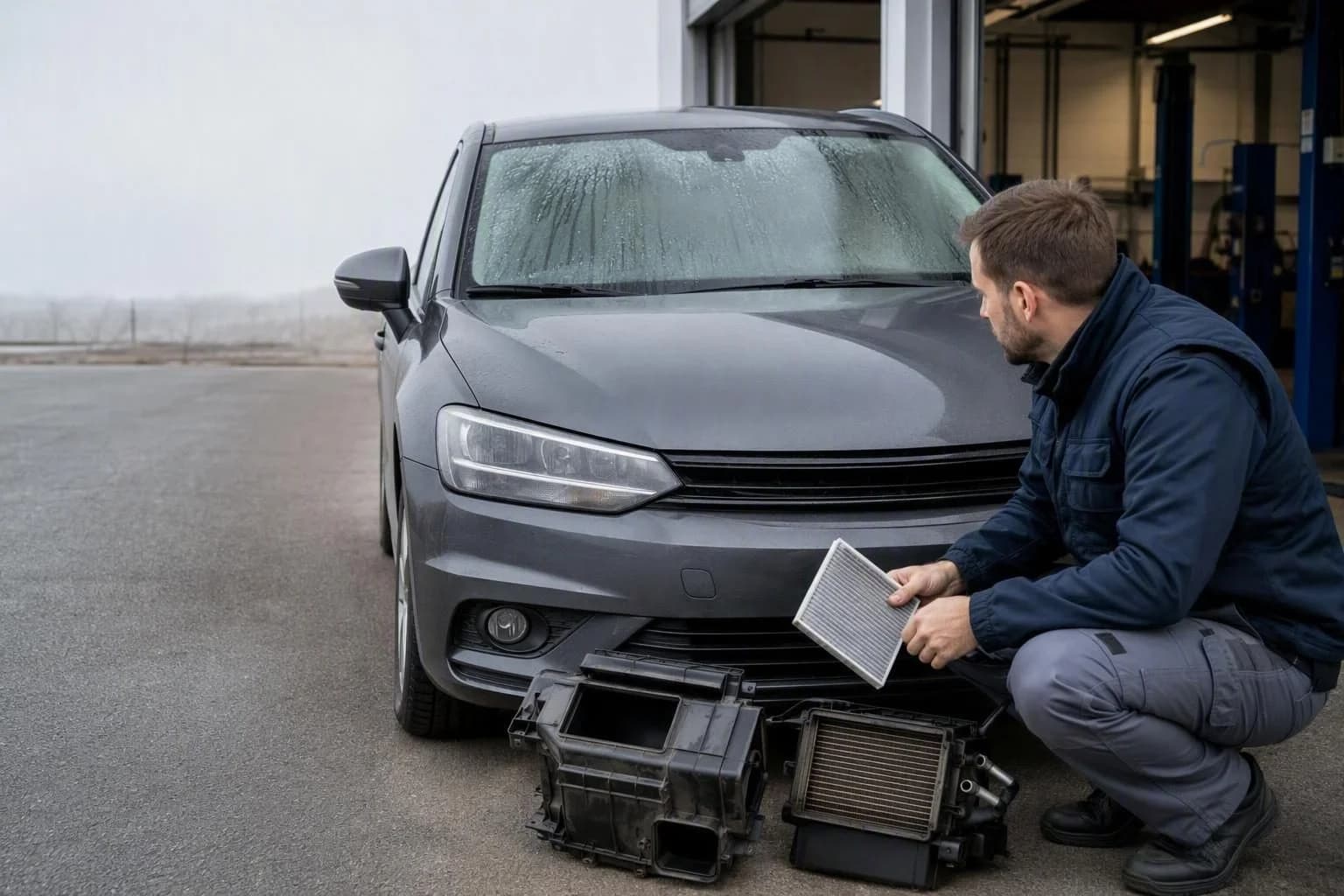
A musty, damp smell from the vents most often points to moisture and dirt around the cabin filter (cabin air filter) or the evaporator (the component that cools the cabin air), or in the airflow path. Air conditioning removes moisture from the air, so the system can accumulate moisture along with contaminants.
If the cabin filter is heavily clogged, the evaporator does not work 'cleanly' and air exchange becomes less efficient.
Drivers typically report two scenarios: (1) AC cools for a short time, then the smell increases and the effect weakens, (2) the smell appears immediately when switched on and cooling is only 'so-so'. That means, alongside the refrigeration circuit, check the air side and cabin cleanliness.
Cleaning and replacing the cabin filter is often part of a sensible plan, not mere 'cosmetics'.
AC works intermittently or stops after a while — when does this fit a leak?
Uneven AC performance (cooling sometimes works, sometimes not; effect returns after a stop; cooling weakens during driving) is often related to refrigerant loss or difficulty maintaining proper operating parameters. A leak can give subtle symptoms: the system starts correctly but loses cooling after a while.
The air conditioning system is like a circuit with precise operating conditions. If one parameter is outside its range, the control unit may limit compressor operation to protect components. The driver perceives this as weaker cooling or temporary breaks in effect.
In this situation simply topping up refrigerant rarely fixes the issue if the source is not found. Sensible diagnostics start with assessing operating parameters and searching for a leak, otherwise the problem will return.
- Symptom: cooling effect drops after some operating time (e.g. after prolonged city driving).
- Symptom: cooling returns after switching AC off and on again.
- Symptom: problem grows despite 'reacting' while driving (e.g. increasing fan speed without temperature improvement).
- Risk: continued use under incorrect conditions can reduce lubrication and accelerate component wear.
AC stopped cooling suddenly — can I still drive or is it better not to?
A sudden loss of cooling can result from trivial things (e.g. blocked air components), but it can also mean the control unit has detected a fault and gone into a protective mode. Then the air conditioning stops or works 'very weakly'.
If you also see an error message on the dash or notice abnormal behaviour of the compressor (the AC pump) or fans, don't delay.
Safety is more important than comfort. In hot weather the cabin becomes uncomfortable quickly and the driver tires sooner. Plan to reach the garage promptly, avoid driving with maximum load and watch whether the problem worsens.
- You can drive if AC only cools weakly and there are no unusual noises or dashboard messages.
- Better postpone driving and book a diagnostic appointment as a priority if there are dashboard errors or AC switches off immediately after activation.
- Do not ignore 'inflammatory' symptoms (a burning smell) — this signals the system may be operating in abnormal conditions.
What does AC diagnostics in the garage look like — what is the goal and what is just a step?
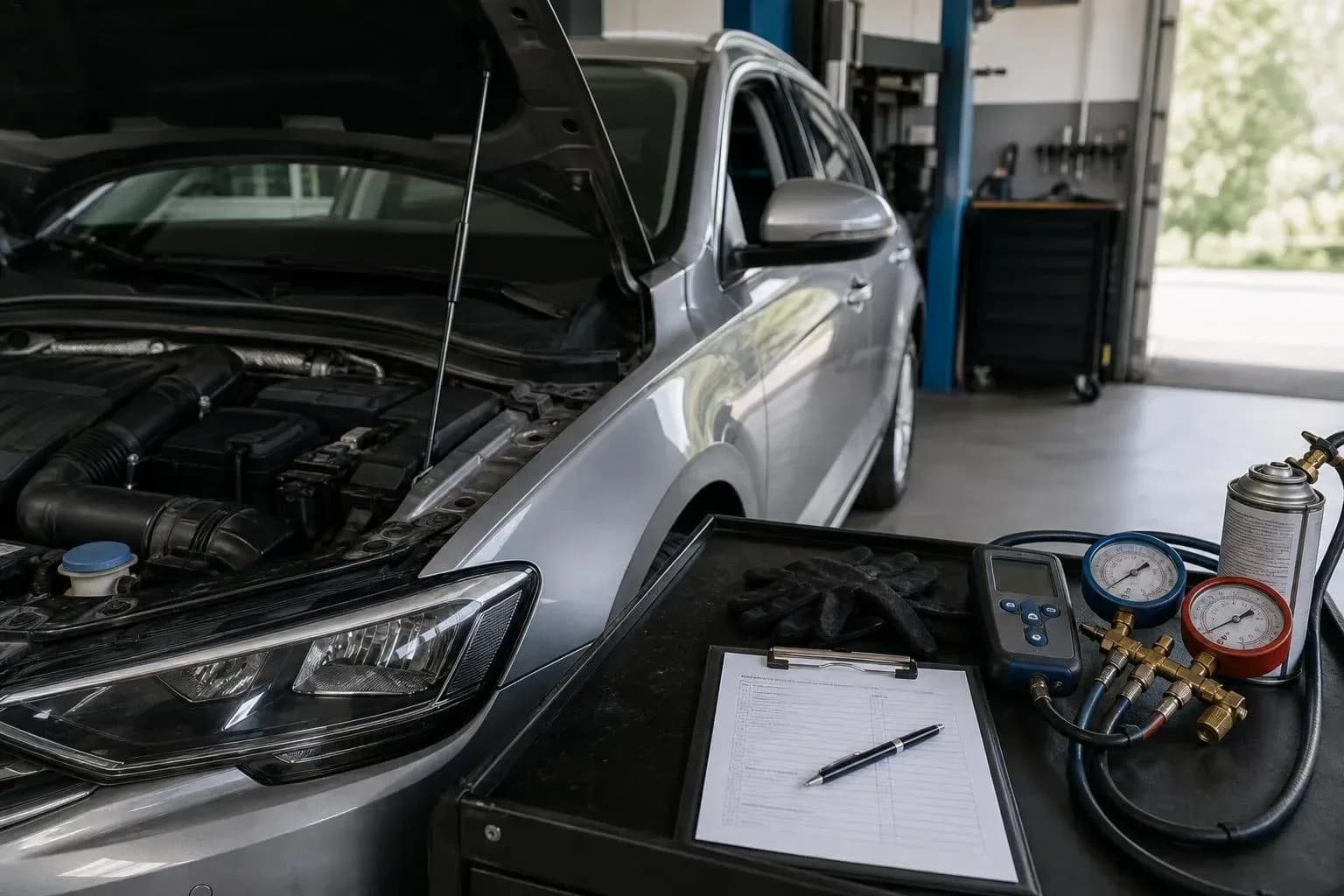
In a good garage, AC diagnostics should not start with guessing based on 'how it was before'. First we organise the symptoms, then check system operation and only afterwards take measurements. In practice this means: assessing fan and control operation, verifying component behaviour and checking system parameters.
If an error appears during driving or after switching on AC, it is not a 'feeling'. It is information for engine and AC diagnostics about which area the system limited. That's why it is important to arrive at the garage with a clear description: whether the problem is constant, intermittent and how soon after switching on AC it appears.
- Interview and symptom description: when it happens (after a stop, after warming up, on the road), how the vents behave and whether there are smells or messages.
- Initial check: whether the system starts correctly, how it reacts to setting changes and how associated components behave.
- Computer diagnostics and fault readout: control units can indicate which area detected the irregularity.
- Checking refrigerant system parameters: matching effect to the system's operating requirements.
- Further steps depend on the result: repair the root cause (e.g. cleanliness, control elements or locating a leak).
How to describe the problem to diagnostics to find the cause faster?
Your observations save diagnostic time. The mechanic does not see your car right now, so they need as precise data as possible. Instead of saying 'the AC doesn't work', try to answer a few short questions.
If you can, note the conditions: outside temperature, whether AC works better on the motorway or only in town, and whether the problem appears regardless of engine rpm. These are real clues that help distinguish an airflow-related fault from a refrigeration component issue.
- 'When did it start?' — e.g. after prolonged rain, after a car wash, after service or suddenly after a stop.
- 'How exactly does the AC behave?' — does it weaken gradually or switch off immediately.
- 'Does the vent airflow behave the same?' — if yes, we narrow the problem to the refrigeration side.
- 'What is the smell and when?' — immediately after switching on or after a while.
- 'Are there messages or warning lights?' — even if they disappear after restarting.
How to avoid deterioration and when to book a garage visit?
Air conditioning can create a 'domino effect': when one element works worse, the system compensates and may wear other parts faster. That's why it's better to react when the problem first appears rather than wait until AC stops completely.
This is not to scare — it is that loss of comfort usually increases the risk of control errors and operation in suboptimal conditions.
Booking diagnostics makes particular sense when: cooling weakens week by week, a musty smell appears every time AC is started, the air conditioning works only intermittently or you have the impression the compressor does not hold parameters.
Computer diagnostics then help quickly rule out simple causes and move to tests that actually confirm the fault.
If you describe symptoms (vent airflow, smells, moment when the problem appears) and don't delay, the garage can approach the issue concretely: from checking the air path and controls to verifying refrigerant system parameters.
Next step? Book an AC diagnostic, taking a short note on how the air conditioning behaves in your car.