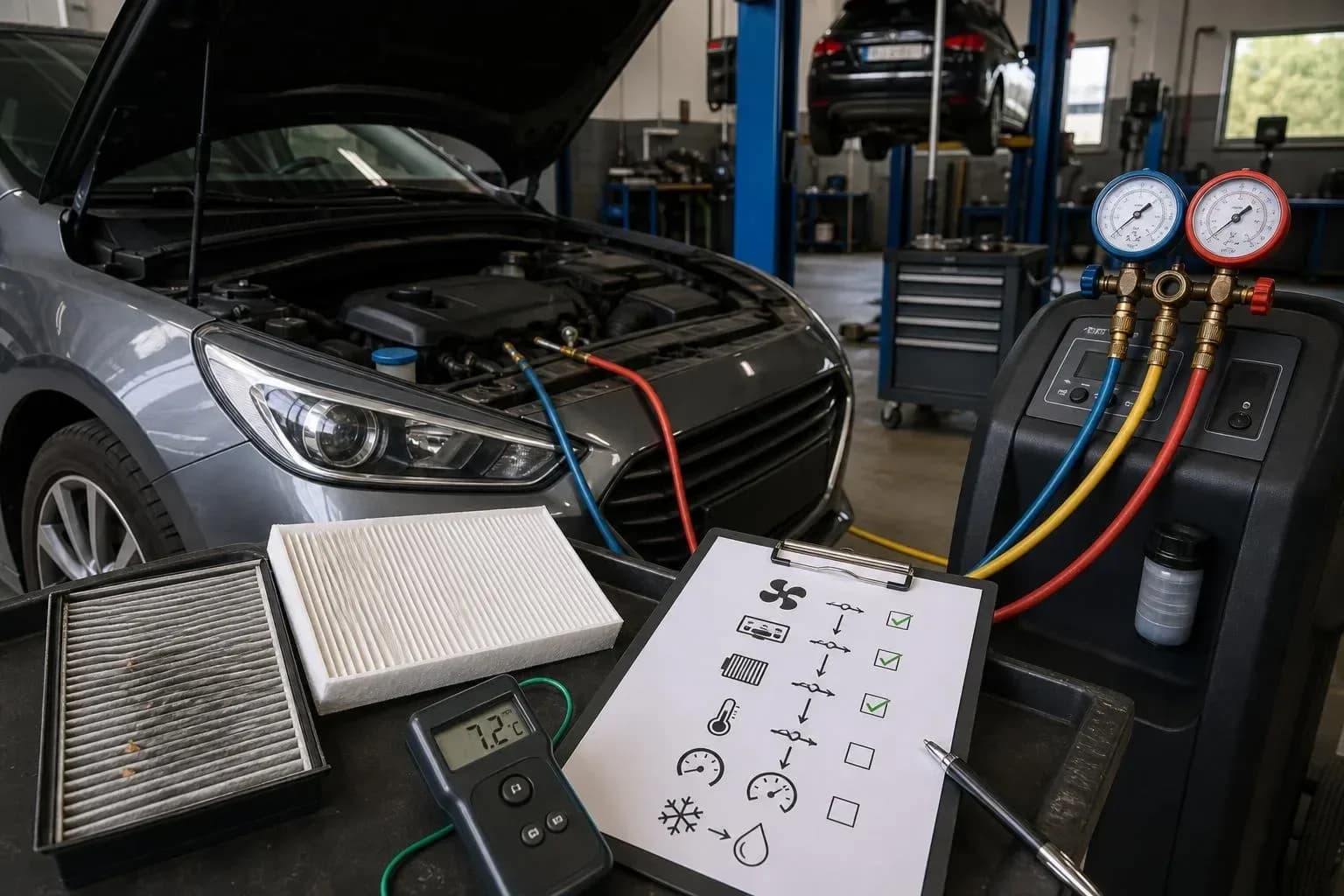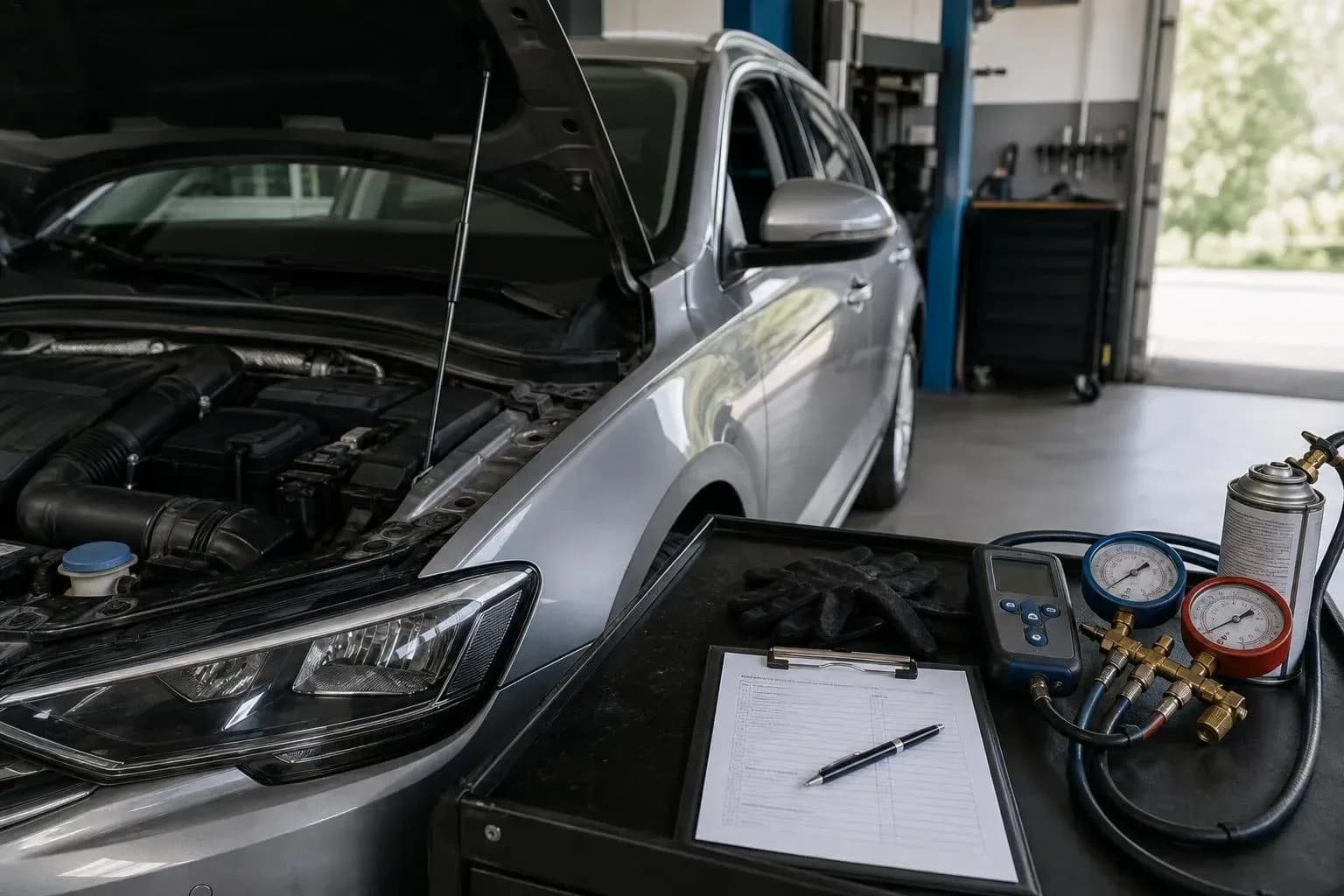
If the air conditioning cools poorly, blows weakly or an unpleasant, musty odour appears after switching it on, the cause is usually poor airflow or moisture in the system. Before you hand the car in, you can perform simple checks to assess the symptoms and avoid driving with a fault that will worsen over time.
In this guide I will suggest what to check from the driver’s seat: whether the problem is constant or depends on the vent mode, how the fan behaves and whether the odour points to a dirty evaporator or to moisture backing up. This helps you tell the workshop what to look for so the repair is chosen based on diagnosis, not guesswork.
Why does the air conditioning cool less and blow weakly?
Weaker airflow or poorer cooling does not necessarily mean there is immediately a lack of refrigerant. Very often the cause is something blocking airflow or preventing effective drying: a dirty cabin filter, a clogged inlet to the heater core/air distribution system, a blocked receiver/drier or evaporator, or a fault in the fan/damper control.
Sometimes the problem is purely electrical – a control unit or sensor not controlling the system as it should.
How to recognise a musty odour: common causes
An unpleasant odour usually appears when the air conditioning fails to dry properly and moisture remains around the evaporator. This encourages microbial growth and a 'damp' smell that builds up after the car has been parked.
Another scenario is odour from debris in the vents (e.g. dust, leaves, dirt in the cabin filter or ducts), which only emerges when the fan runs harder.
Did you know... the air conditioning system produces condensate. If this condensate is not drained correctly and drying is poor, moisture remains in the ducts and the smell returns cyclically. That’s why a simple cabin 'freshener' usually only masks the problem briefly.
What to check in the car in 5–10 minutes before you go to the workshop?
Do quick, repeatable checks. They do not replace full diagnostics, but they let you decide whether the issue is more likely 'airflow', 'moisture and contamination', or 'control/electronics'. In practice this helps you describe the symptom to the workshop and reduces blind trial-and-error.
- Set the panel to cooling and check: does the vent blow weakly always, or only in one mode (e.g. windscreen/feet/face, 'auto' vs manual).
- Roughly gauge the temperature difference: when the AC is on is the air noticeably cooler, or only slightly cooler.
- Check the odour: does it occur only at start-up after parking, or does it persist throughout the drive.
- Observe the fan behaviour: do you hear distinct speed changes, whirring, skips or 'strange' fluctuations in airflow strength.
- Do a fan-off test: switch off the air conditioning but leave the fan at the same speed – if the odour disappears immediately, the cooling circuit and moisture nearby are usually to blame.
- Check the cabin filter 'for signs': if it has recently been visibly dirty or clogged, or the car tends to have weak airflow, the filter is often the first suspect.
When is it better to stop using the air conditioning and get diagnostic checks sooner?
There are situations where you should not drive more miles assuming it’s only a temporary discomfort. The main risks are not so much the AC itself as secondary effects: persistent moisture can worsen comfort and visibility (window fogging), and faults in electrical components can cause unstable fan behaviour or control errors.
If any of the listed symptoms occur, a sensible plan is to limit AC use until verification and book diagnostics. In practice you can often drive normally, but without relying on drying and without driving solely for comfort.
- A very strong musty odour that returns immediately after a short stop – usually a sign that there is moisture and contamination in the system that cannot be 'refreshed'.
- Windows start to fog up faster, even when you set airflow to the windscreen – this may mean the AC is not drying as it should.
- The vent works unevenly: sometimes strong, sometimes weak, with speed jumps or suspicious noises.
- The air conditioning does not respond to settings (e.g. will not switch to cooling) while the fan runs normally, or the opposite.
Which checks to order at the workshop when airflow is weak or there is an odour?
At the workshop the best approach is: first check the airflow and ventilation, then the refrigerant and control systems. With weak airflow and odours ask for a diagnostic package matched to the symptoms, because the symptoms indicate where to look.
Only after these steps does it make sense to decide on cleaning, servicing the circuit, topping up or repairing specific components. This way the cost rises not because 'something else had to be done', but because the service follows the diagnosis.
- Verification of airflow: condition of the cabin filter, duct patency and operation of ventilation components.
- Check of drying and moisture: assessment of the evaporator for contamination/residual moisture and the condensate drainage method.
- Computer diagnostics of the air conditioning system: readout of sensor data and control parameters (so you do not have to guess whether the issue is the control unit, a sensor or the system itself).
- Check of fan and damper control: if the vent behaviour is uneven, the regulating components are a common lead.
- Assessment of the whole operation: does the system actually enter cooling mode and does it react to setting changes as expected.
How long can you drive with such air conditioning and what should you not risk?
If the AC cools weakly but there is no window fogging, the odour is light and the fan runs fairly stably, you can usually get to diagnostics within a reasonable time. There is no point in 'stress-testing' it on long trips if the odour is clear or drying does not work – comfort quickly turns into a visibility problem.
Also avoid experiments that may worsen the situation: do not rely only on cabin chemicals, do not ignore a strengthening odour and do not use modes that worsen fogging. The longer the drying problem persists, the higher the chance moisture will return and 'refreshing' will not have a lasting effect.
How to prevent recurrence of symptoms after an air conditioning service?
The best prevention is checking consumable items and habits. If the problem was contamination and moisture, the key is usually keeping the cabin filter clean and ensuring the system has conditions to dry properly. In practice this means preventing conditions that allow moisture to return.
If your AC blows weakly, cools worse or smells musty, treat it as an invitation to diagnose, not as 'summer nuisance'.
Book a visit and describe when the odour and weak airflow occur and whether they depend on the mode – this speeds up finding the cause.
- Replace or check the cabin filter according to actual wear (dust, pollen, heating season).
- After long parking in damp conditions avoid immediately blasting maximum cooling 'to get rid of the odour' – better run the AC for a few minutes and observe the reaction.
- If the odour returns after a short break, do not wait months – it usually means the source of moisture was not removed.