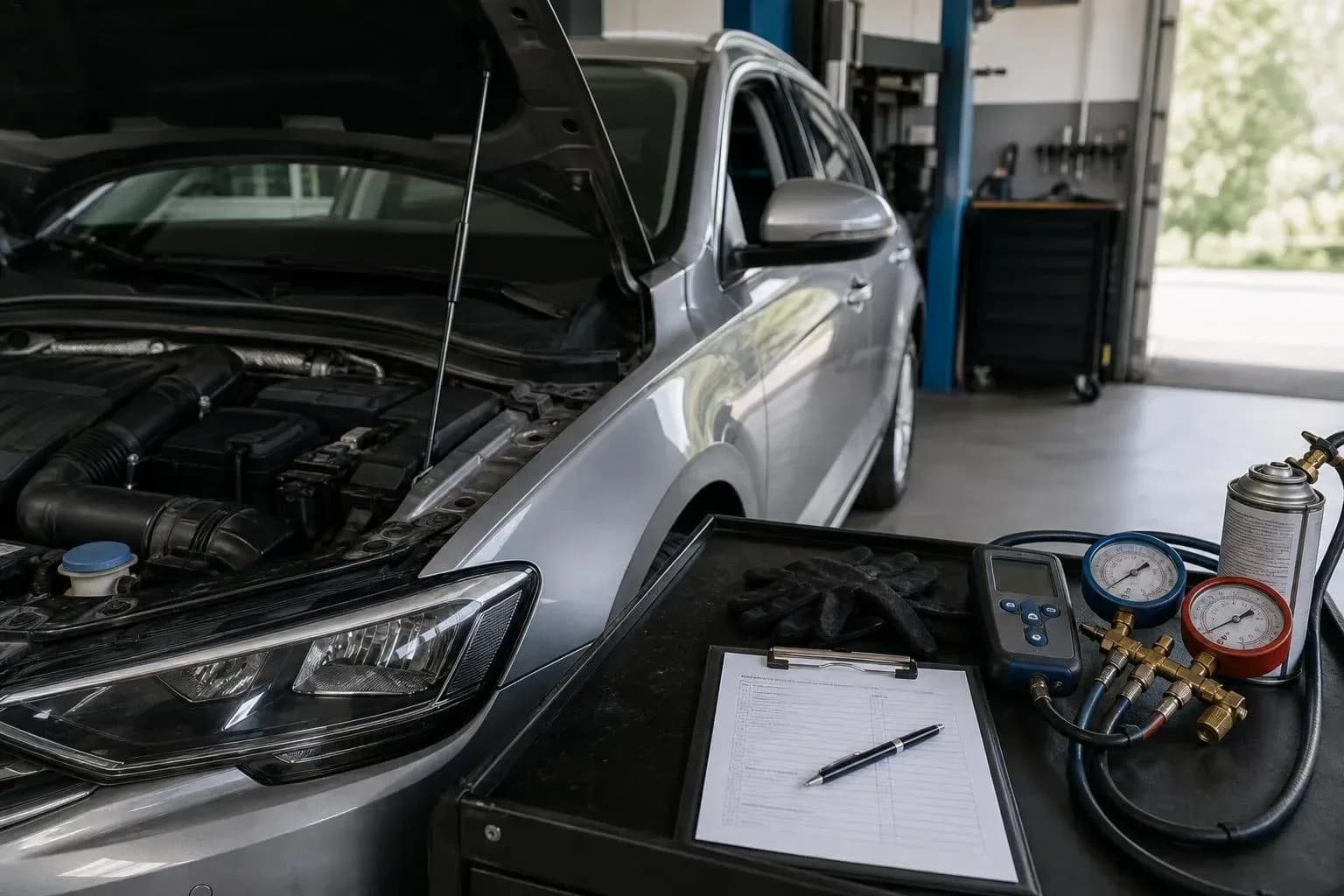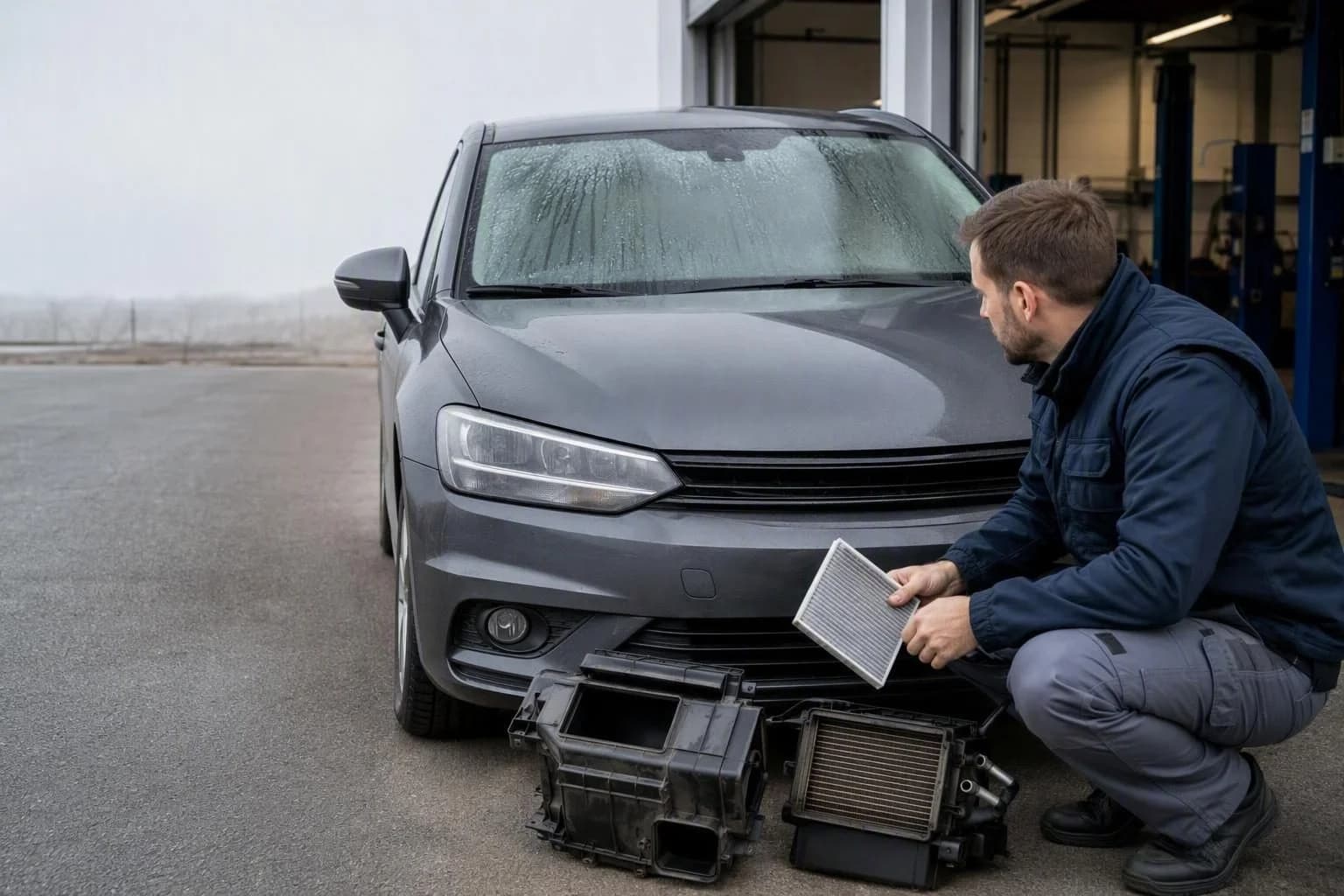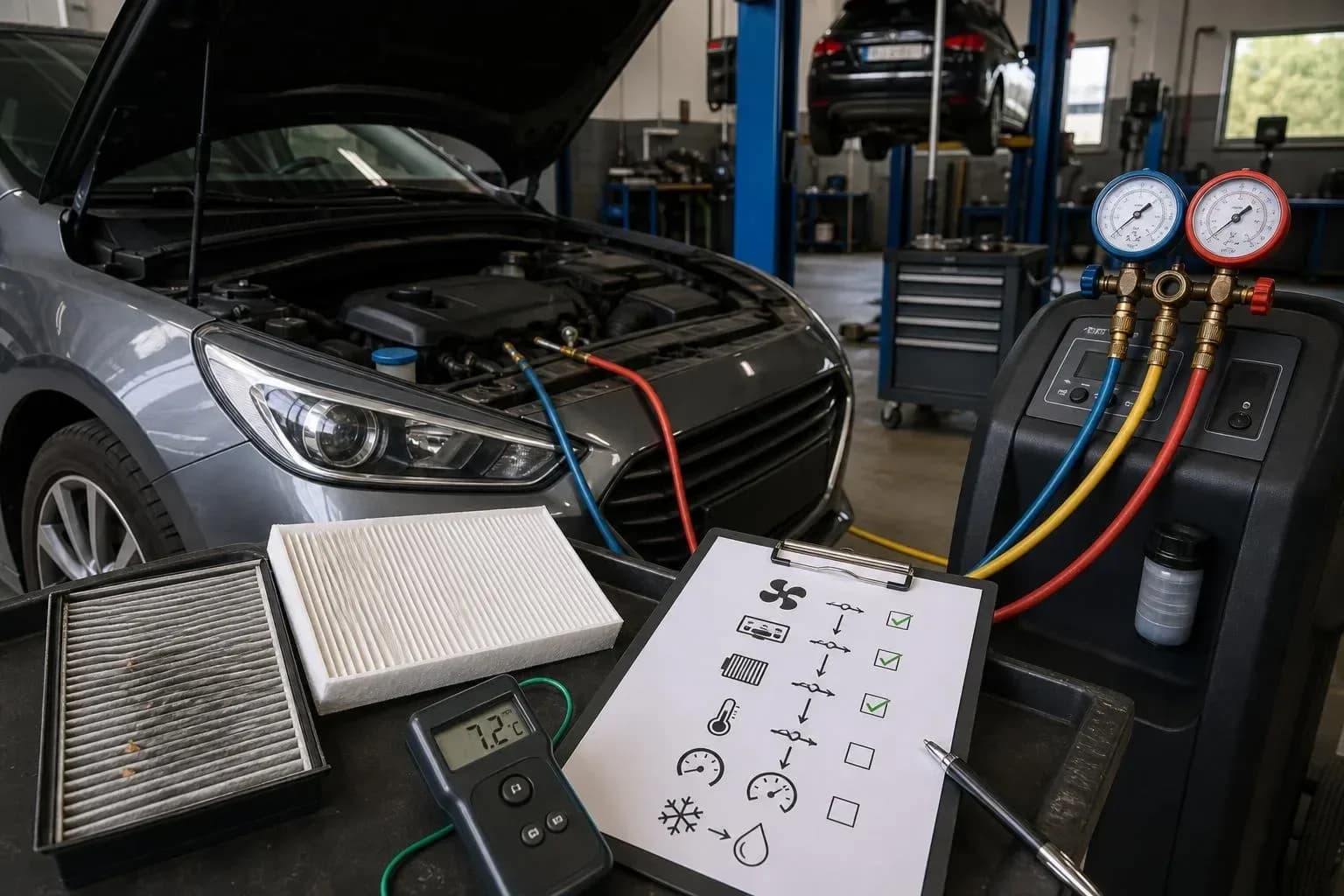
If the air conditioning cools poorly, don’t assume a recharge will fix it. First rule out simple causes: wrong settings, weak airflow, a clogged cabin filter or a non‑working condenser fan. Only measurements of temperature, pressures and refrigerant amount can show whether it’s a loss, a leak or another system fault.
What to check before you conclude there is a lack of refrigerant?
Start by checking things the driver can assess without tools or taking the system apart. Poor cooling is often confused with restricted airflow, so the vent temperature alone does not prove the air conditioning is low on refrigerant.
- Set the lowest temperature, switch on A/C mode and set the fan to medium or high.
- Check that a defrost or warm‑air mixing mode is not on, which changes the perceived coolness.
- Compare airflow from different vents: if one side is noticeably warmer, the issue may be with flap control or air mixing.
- Pay attention to the airflow strength.
- Check whether the problem occurs only in congestion or also when driving at higher speed.
Also observe the test conditions. Air conditioning behaves differently after parking in full sun than after a few minutes of steady driving. A short test is best done with the windows closed, similar settings and after several minutes of system operation.
Does simply recharging the air conditioning make sense?
Recharging the refrigerant only makes sense as part of a correct service when you know how much refrigerant the system should contain. Air conditioning is not a system that should regularly 'consume' refrigerant like fuel or washer fluid. Low refrigerant often indicates a leak or earlier incorrect servicing.
Repeated topping up without finding the cause can briefly improve cooling but does not solve the problem. The symptom usually returns and the system may then run in improper conditions. Additionally, the refrigerant must be selected and measured according to the car maker’s data, because both shortage and excess can worsen air conditioning performance.
Be cautious about ad‑hoc additives marketed as "leak‑stop". Technical documentation describes them as potential sources of blockages and compressor problems, so they should not replace leak diagnostics.
Which symptoms more likely match refrigerant loss or a leak?
A refrigerant loss is more likely when the air conditioning previously worked well and cooling gradually weakened or returned only briefly after the last service. That is not definitive, because similar sensations can be caused by the fan, condenser, sensors or controls.
- The vent is cool but never gets noticeably cold, even after several minutes of driving.
- The air conditioning works intermittently: it cools sometimes and then stops, without an obvious change in settings.
- After a previous refrigerant top‑up the improvement was short‑lived and the symptom returned quickly.
- You hear frequent cycling of the system on and off or the cooling is unstable.
- You can see a greasy film or dirt on system components at a possible leak point, although visual inspection alone is not enough for a certain diagnosis.
In that situation it’s better not to plan another blind top‑up. First check system tightness and operating parameters, and only then refill with the correct amount of refrigerant.
When is the fault the airflow, the filter, the fan or the condenser?
A flow‑related problem is likely when too little air comes from the vents or cooling worsens mainly in traffic. A clogged cabin filter reduces vent performance, and a faulty condenser fan can cause poorer heat rejection, especially when stationary or at low speeds.
The condenser, the front‑mounted component that rejects heat from the air conditioning, can be dirty, mechanically damaged or have restricted airflow. The symptom does not have to be a total loss of cooling. Sometimes the system works at road speed but weakens noticeably in town, when natural airflow through the front of the car is reduced.
The cabin filter is a simple but often overlooked lead. If airflow is weak, windows defog more slowly and an unpleasant smell appears in the cabin, checking the filter and the vent ducts is a sensible first step.
Can you drive when the air conditioning cools poorly?
Usually poor air conditioning does not require an immediate stop, but it can affect comfort and visibility. If the system is not dehumidifying the air, windows may fog faster in rain or high humidity, which reduces driving safety.
Do not delay checks if, in addition to poor cooling, you notice unusual noise from under the bonnet, a burning smell, error messages, engine overheating or a total lack of response when switching on A/C. Continuing to drive then may worsen the fault, especially if it concerns accessories, the fan or control elements.
How to approach diagnostics without guessing?
The most sensible order is: first confirm the symptom, then measure parameters, and only at the end replenish refrigerant. Air conditioning and cooling service should base the decision on the test conditions, temperatures, working pressures, filter condition, condenser and fan state, and the manufacturer’s data on the type and amount of refrigerant.
1. Describe when the air conditioning cools poorly: after parking, in traffic, on the road, only after the engine warms up or all the time.
2. Check settings and airflow strength so you do not mistake lack of cool for restricted airflow.
3. Note whether the system was previously topped up and how quickly the symptom returned.
4. In the workshop, start with measuring temperatures and operating parameters, not with random refrigerant top‑ups.
5. If there are control errors, a non‑working fan or unstable system engagement, computer diagnostics may be helpful.
This sequence reduces the risk of replacing good parts and helps distinguish real refrigerant loss from problems with the airflow, condenser, fan, compressor or controls. In air conditioning, one symptom rarely suffices for a certain diagnosis.
What is the practical next step?
If the air conditioning has only slightly weakened, start with settings, airflow and the cabin filter. If cooling returns only briefly after topping up refrigerant, weakens in traffic or works irregularly, don’t repeat topping up without checking for leaks and measuring operating parameters.
The best next step is calm diagnostics of the system, and only then a decision on refrigerant service or repair of the specific cause.