A jumping fuel gauge is a common fault that can mislead the driver and cause unnecessary stress. Symptoms range from small fluctuations to a sudden “reserve” indication even though there is still fuel in the tank.
This article describes the most likely causes, what you can safely check yourself and how a workshop carries out diagnostics. We do not provide instructions for DIY repairs of the fuel system.
How to read the symptoms — what exactly does “jumping” mean?
“Jumping” of the gauge means unstable, sudden changes in the fuel level reading while driving or after refuelling. Typical manifestations include: the reading changes when the car is shaken, the gauge does not show a full tank after refuelling, or the reserve indicator appears suddenly.
These symptoms do not always mean fuel is disappearing — more often there is a problem with reading the fuel level. It is important to observe whether the car behaves normally in terms of power and drivability. If you experience loss of power or stalling, treat the issue more seriously.
- Unstable reading during movement and vibrations — suggests a loose connection or worn contacts.
- No response after refuelling — could be a mechanically stuck float or an electronic delay.
- Reading returns after shaking the car — a typical sign of an intermittent contact.
Main groups of causes
Causes can be divided into four groups. Knowing them helps understand why repair usually requires a workshop.
1) Mechanical problem in the tank — the float and arm: most cars measure fuel level with a float connected to a resistive element (the so‑called sender). If the arm is damaged, the float leaks or jams, the signal will be unstable.
2) Electrical problems: power interruptions, poor earths, corroded contacts or a damaged wiring harness to the module in the tank cause intermittent signal loss. The reading returning after a shock is a typical symptom of this fault.
3) Instrument cluster failure: the instrument itself may have damaged electronics or stepper motors that drive the needles. In that case the signal from the sender is correct but the display on the dash is not.
4) Communication and control errors: in modern cars the fuel level information can be routed via the pump module, the BCM or the CAN bus to the cluster. A communication or software fault can produce misleading readings.
- Float mechanics — wear, jamming, damaged arm.
- Wiring and earths — broken wires, corroded connectors.
- Instrument cluster — failures in the cluster electronics.
- Data bus/ECU — communication errors or stored faults in a controller.
How professional diagnostics are carried out in a workshop?
Diagnostics include several stages that allow a technician to distinguish a mechanical fault from an electrical one or a software error. The outline below is indicative — exact procedures depend on the vehicle model.
The diagnostic steps most often are:
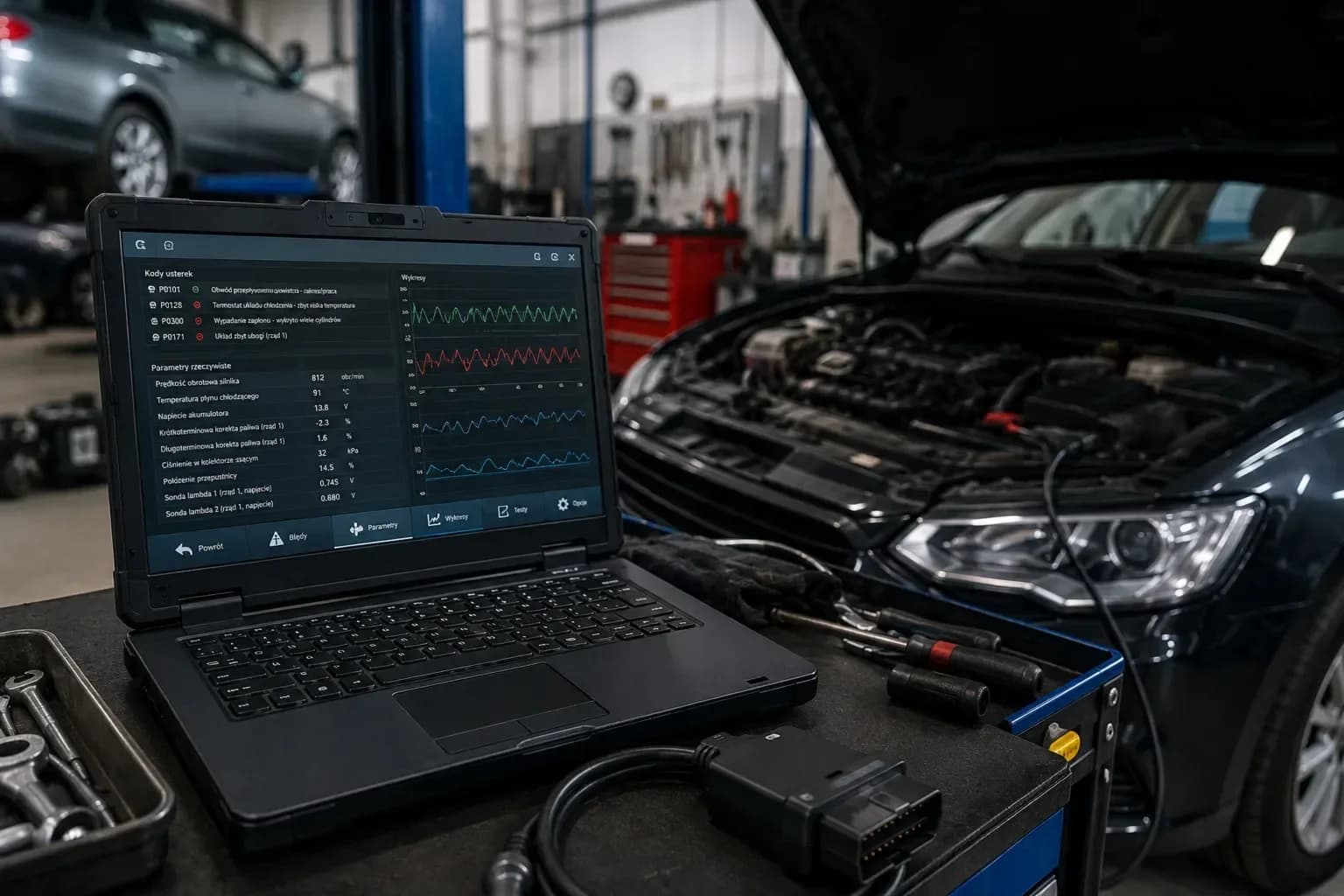
• Reading fault codes and live data with an OBD scanner: comparing the ECU live value for fuel level (PID) with the value shown on the dash. This helps determine whether the fault is at the sender, on the bus or in the cluster.
• Electrical measurements of the sender: checking resistance/variation of the signal while the float moves. A workshop can perform measurements without full removal or after partial access to the tank module.
• Checking earths and connections: inspecting connectors, wiring and earthing points, looking for corrosion or damage in the harness to the tank.
• Testing the instrument cluster: if the scanner shows a correct signal but the dash does not respond, the technician checks the cluster itself — its power supply and control signals.
• Analysing CAN/BCM/ECU communication: reading specific messages on the bus and checking whether values exchanged between modules are consistent.
On this basis the workshop proposes repair or replacement of the specific component. Removing the pump/float requires working at the tank and should be performed by a service.
- OBD scanner: compare ECU data with the dashboard display.
- Resistance measurement and simulated float movement.
- Inspection of connectors, earths and wiring harnesses.
- Tests of the instrument cluster and CAN communication.
When to limit or stop driving?
If the problem concerns only the gauge and the car drives normally — there is no need to stop immediately, but arrange urgent diagnostics. An irregular reading can lead to unexpected fuel depletion, so caution is advised.
Stop driving immediately and call roadside assistance if you observe any of the following:
• The vehicle loses power, stalls or has trouble starting — this may indicate a fuel pump failure or a serious fuel delivery problem. Such symptoms can be dangerous in traffic.
• The gauge shows reserve and you have reason to believe fuel is actually running low — refuel as soon as possible to avoid becoming stranded.
In risky situations do not attempt DIY repairs at the tank or on the fuel. It is safer to reach a service by towing or call for assistance.
- Normal driving, only jumping readings → book diagnostics.
- Loss of power/stalling → stop driving, call roadside assistance.
- Suspected real fuel shortage → refuel, do not take risks.
What you can check before the visit and how to prepare the car for diagnostics?
There are simple, safe actions that will make the diagnostic work easier:
• Note the circumstances when the jumps occur: whether it happens at a certain speed, over bumps, after refuelling or after a long drive. The more details, the quicker the mechanic can narrow the search.
• Check whether the fuel gauge reacts when the ignition is switched on (electronics on, engine not necessarily running). This is a quick clue whether the cluster receives a signal.
• Inspect visible battery earths and terminals — are they clean and properly tightened. Do not work under the bonnet if you lack experience with electrical systems.
• If you have service records or previous notes about similar issues, prepare them before the visit.
More practical tips on preparing a car for diagnostics can be found in the article: jak-przygotowac-samochod-do-diagnostyki-zeby-ulatwic-znalezienie-usterki.
- Record the conditions when the fault occurs (speed, surface, after refuelling).
- Check the gauge reaction when the ignition is switched on.
- Inspect the condition of battery terminals and visible earths.
Summary and next steps
A jumping fuel gauge is rarely a symptom of a single, easy-to-fix fault — it usually requires diagnostics that include sender measurements, earth checks and analysis of communication between modules.
Do not attempt to remove the pump or work on the fuel tank yourself. If the readings affect driving safety (loss of power, stalling) — limit driving and call for assistance. Otherwise arrange professional diagnostics: computer diagnostics.
bullets:[
Problem may be mechanical, electrical, in the cluster or in module communication.
Professional diagnostics are necessary to reliably determine the cause.
If there is risk, stop driving and contact roadside assistance.
- Problem may be mechanical, electrical, in the cluster or in module communication.
- Professional diagnostics are necessary to reliably determine the cause.
- If there is risk, stop driving and contact roadside assistance.