Imagine someone constantly monitoring fuel quantity, engine temperature, boost pressure, mixture composition, turbocharger operation, lambda sensors, injectors, the throttle and dozens of other components while you drive.
Sounds like the job for an entire team of engineers?
Key facts
And yet it is done by a device the size of a small book.
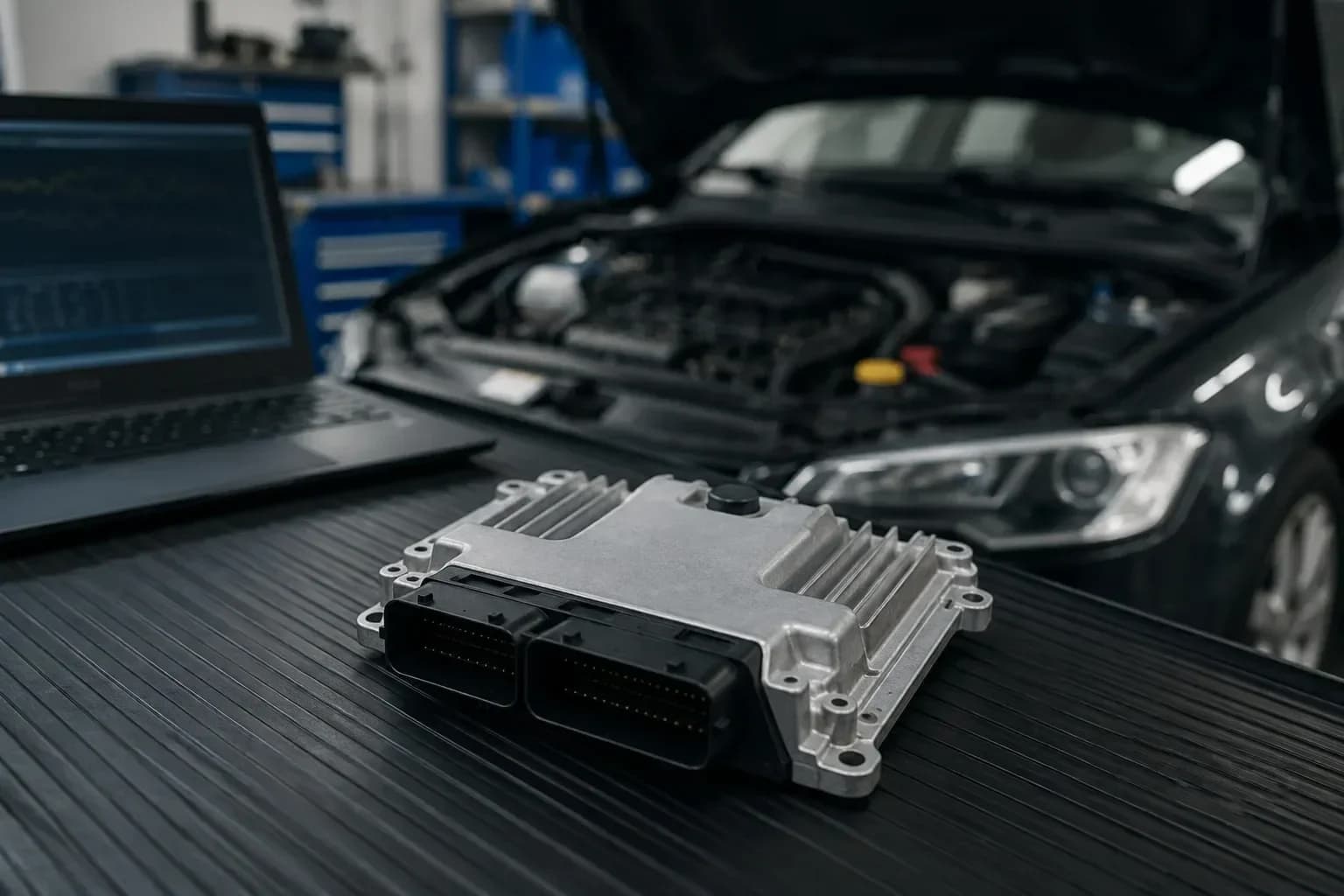
This is the ECU – the electronic engine controller, often called the “brain” of the car.
ECU (Engine Control Unit) is the computer that controls the engine. It receives information from many sensors located around the vehicle and, based on that data, makes decisions about the operation of the powertrain.
Every press of the accelerator, switching on the air conditioning or a change in engine temperature causes the ECU to recalculate operating parameters in real time and adjust settings.
That is why the car is more economical, more responsive and meets strict emission standards.
The engine controller receives data from, among others:
crankshaft position sensor,
mass airflow sensor,
lambda sensors,
temperature sensors,
boost pressure sensor,
accelerator pedal,
knock sensors,
ABS and ESP systems,
the transmission,
the immobiliser system.
Based on this information the ECU controls fuel injection, ignition timing, turbocharger operation and many other systems.
Fortunately, no.
More often the problem involves a sensor, wiring or the controller’s power supply rather than the computer itself.
That is why professional diagnostics always start with checking all components that work with the ECU.
At e-CarService we analyse the controller’s communication with other vehicle modules, check supply voltages, operating parameters and the fault history. This lets us distinguish a real ECU failure from issues caused by a faulty sensor, wiring or another component.
A car arrived at e-CarService after its owner had been told: “the engine computer is faulty”. After detailed analysis it turned out the controller was fine and the problem was unstable power caused by a damaged grounding cable. The repair cost was a fraction of what the customer would have paid to replace the ECU.
🟢 Today – an occasional Check Engine light.
🟡 In a few weeks – degraded engine performance.
🟠 In a few months – damage to additional components.
🔴 In extreme cases – costly repair of the fuel injection system, turbocharger or catalytic converter.
That is why it is not worth ignoring even seemingly minor symptoms.
A modern engine controller performs several million calculations every second. In the newest cars it communicates with dozens of other controllers over the CAN bus, creating an extensive electronic network for the whole vehicle.
Can the ECU be repaired?
In many cases, yes. It all depends on the type of fault.
Does disconnecting the battery reset the ECU?
It may clear some adaptations, but it does not fix faults stored in the controller.
Can you replace the ECU yourself?
It is not recommended. Modern controllers require coding and synchronisation with the immobiliser and other vehicle modules.
- What is OBD?
- How does computer diagnostics work?
- Why is the Check Engine light on?
- Car won’t start? Check before calling for help.
- How does the ABS system work?
- Why is the ESP light on?