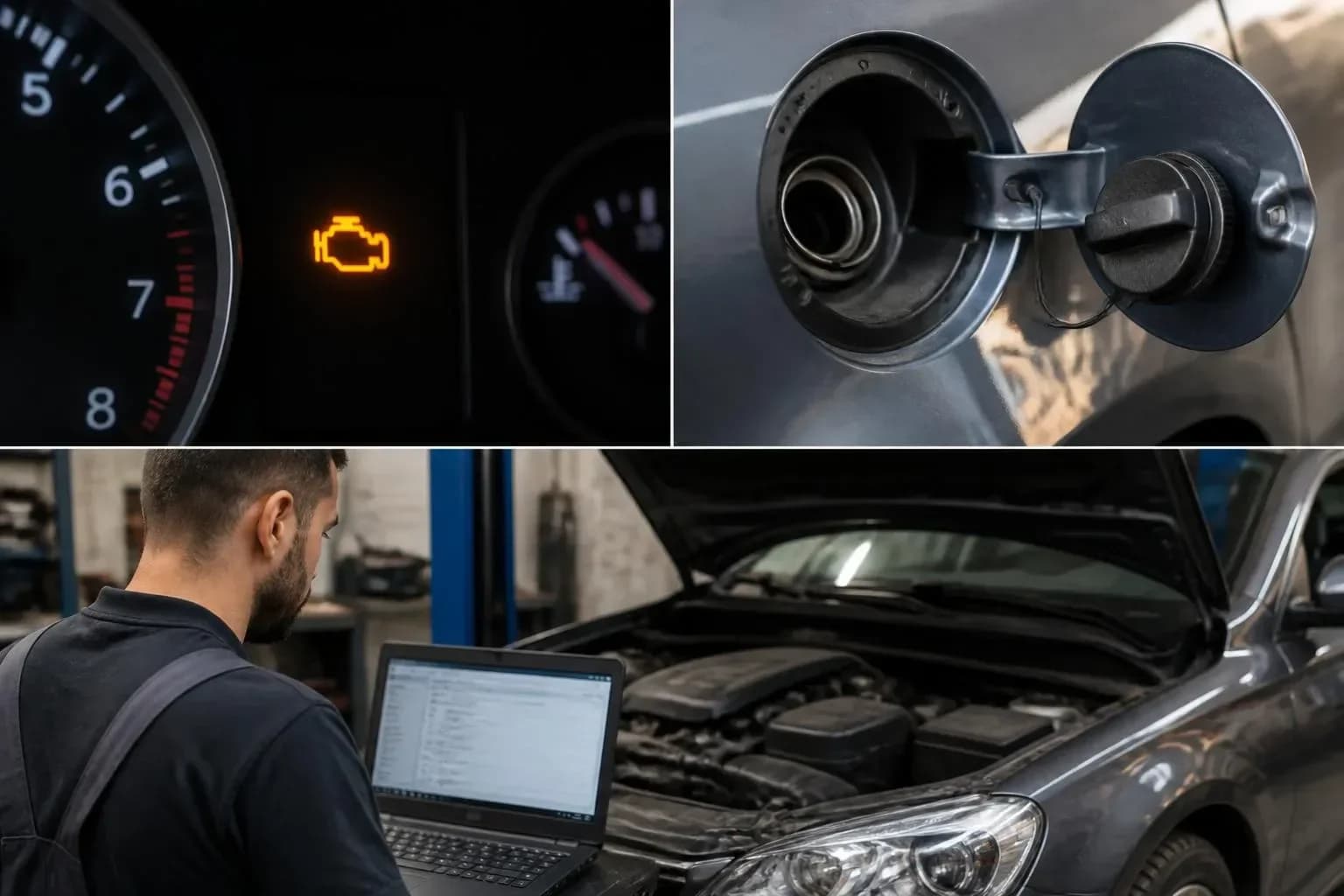
If you smell fuel in the car, first judge the strength of the odour and where it is coming from. A brief smell after refuelling or following a failed start can fade, but a strong smell in the cabin, under the bonnet, increasing while stationary or a wet patch under the car are signs to stop driving safely.
Fuel vapours are flammable, so this symptom should not be treated as a mere nuisance.
When can a fuel smell be only temporary?
A temporary fuel smell can appear after refuelling, spilling a few drops at the filler or after a short, unsuccessful attempt to start the engine. In such cases the odour should fade quickly, especially after airing the cabin and driving away from the pump.
If the smell disappears after a few minutes and does not return, it usually does not indicate an immediate serious fault, but it is still worth staying alert.
You should not assume that every smell after refuelling is normal. A loosely fitted filler cap, a damaged cap seal, a problem around the filler neck or the tank venting can cause a recurring fuel odour.
If the smell appeared after several unsuccessful start attempts and the car will not start, it is worth separating two issues: the reason for the no-start and the possible risk of a leak or excess unburnt fuel.
When should you stop the car and not continue driving?
You should stop driving when the fuel smell is noticeable, persistent or appears in the cabin while the engine is running. Particularly worrying are cases where the odour intensifies while stationary, after starting the car, when the bonnet is open or after parking.
The absence of a visible stain does not rule out a problem, because a leak can show only under pressure or in the tank venting system.
- Stop in a safe place away from heavy traffic and sources of fire.
- Turn off the engine if the smell is strong, or comes from under the bonnet or the cabin.
- Do not smoke, do not use open flames and avoid actions that could create a spark.
- Do not lean deep into the engine bay with a hot engine and do not touch fuel lines.
- If you see a fresh wet patch under the car or fuel dripping, do not continue driving.
What can the driver check without tools?
Without tools you can only do a safe external check, without dismantling parts and without inspecting systems on a hot engine. Start with what does not require touching fuel lines or working on pressurised parts. The aim is not to make a diagnosis but to assess whether the risk requires immediate assistance.
1. Check whether the filler cap is properly tightened and whether the area around the filler is wet after refuelling.
2. Look under the car: a fresh stain, a strong smell at the floor level or signs of dripping are reasons to stop driving.
3. Note whether the smell is stronger at the rear of the car, near the filler, under the bonnet or inside the cabin.
4. Open the doors and ventilate the cabin, but if the smell returns quickly after starting the engine, do not treat this as ordinary ventilation.
5. Check messages on the dashboard, the engine warning light and unusual engine behaviour, but do not base your decision solely on warning lights.
What faults can cause a petrol or fuel smell?
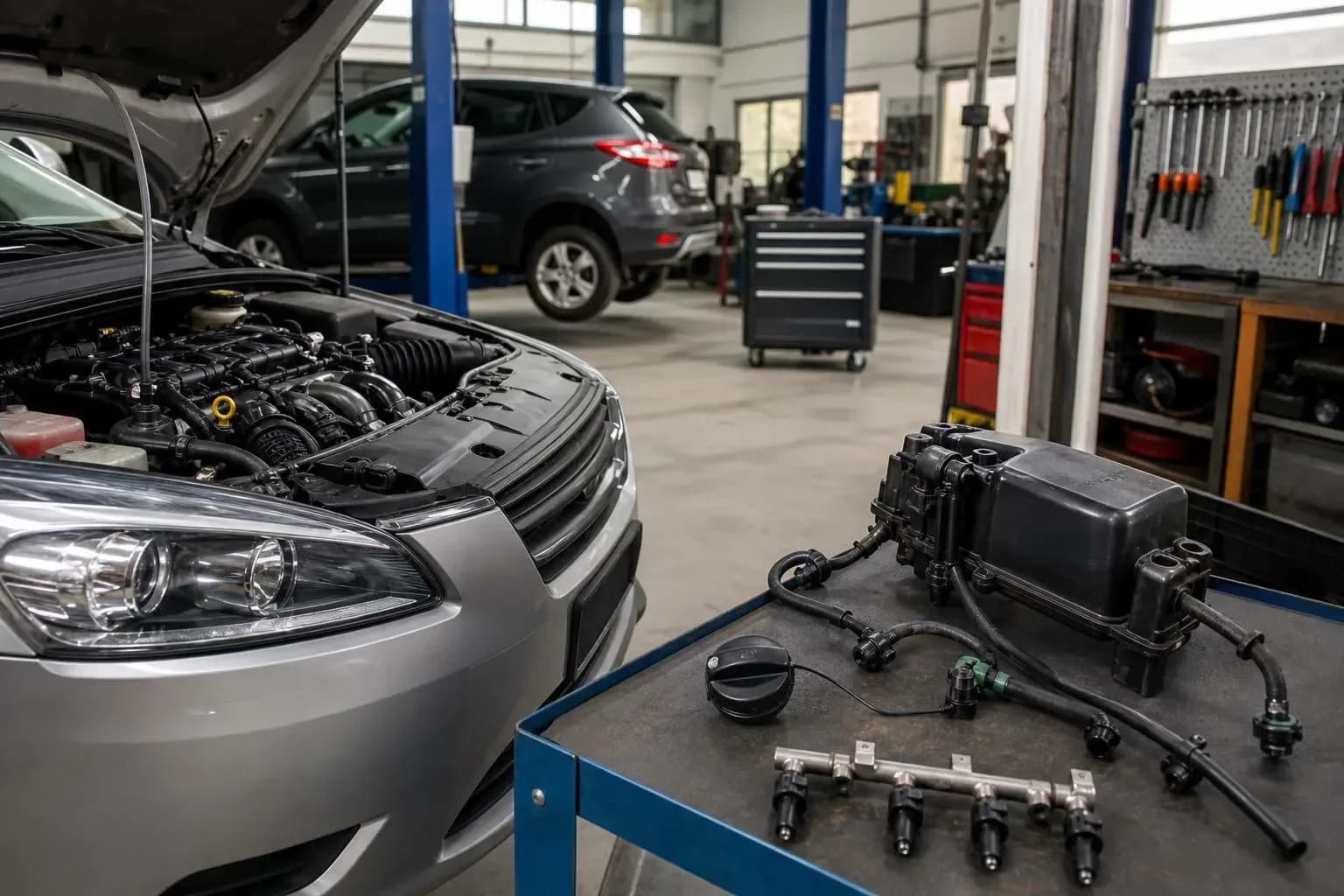
A fuel smell can have several groups of causes, so a single symptom does not reliably point to one part. There may be a leaking hose, a problem at the tank, filler or cap, a leak near the fuel rail, or a fault in the EVAP (evaporative emission control) system.
In some cars the smell may only appear under specific conditions: after filling to the top, while stationary, during starting or with a warm engine.
In petrol engines drivers more often report a petrol smell, but diesel drivers should not ignore a fuel odour either. Diesel is less volatile than petrol, but a leak still needs checking because it can soil underbody components, affect safety and make assessing the vehicle’s condition harder.
In every case it is more important to determine where the smell actually comes from than to guess the cause.
Why does the absence of a stain not mean there is no problem?
The lack of a stain under the car does not exclude a leak because fuel can evaporate, collect on shields or only escape while the pump is running. The fuel system operates in conditions that cannot be reliably assessed by smell alone. Similarly, the EVAP system can cause fuel vapour odour without typical dripping under the car.
Therefore diagnostics should include inspecting areas prone to leaks, assessing the cap and filler, hoses, the tank and parts near the engine. If needed, controller faults and operation parameters of systems related to fuel vapour emissions are also checked. That is the difference between a diagnosis and replacing parts by trial.
Can you drive to a workshop with a fuel smell?
Driving to a workshop can be considered only when the smell is weak, clearly fades after refuelling, there is no stain, no fuel is noticeable in the cabin while driving and the car runs normally. Even then it is best to drive a short distance, calmly, and watch whether the odour returns.
If the smell is strong or comes from under the bonnet, a safer option is to stop driving and arrange an inspection without further starting the car.
A practical rule is simple: a smell that disappears and clearly relates to spilled fuel at the filler can be monitored. A smell that persists, grows, enters the cabin or is accompanied by a stain requires prompt diagnostics. It is not worth chasing the fault while hot or assuming that because the car runs normally the fuel system is tight.
Check the problem with eCarService
We can help assess whether it is safe to continue driving and where to look for the cause.