If you smell petrol in the cabin, under the bonnet or around the car, don’t assume it’s only a brief smell after filling up. The symptom may come from a real leak in the fuel system, but sometimes the EVAP system — the evaporative emissions control system — is responsible.
You can’t confirm this remotely, so the key is to quickly tell whether the smell is faint and short-lived or noticeable and getting stronger.
When a petrol smell is a warning sign
The most worrying case is a smell that persists after locking the car, gets stronger when stationary or appears after turning the fan on. If you also see a stain under the car, smell petrol in the cabin or under the bonnet, or the smell became noticeably stronger after the last drive, don’t delay a check.
Fuel vapour is flammable, so with a strong smell it is wiser to stop driving than to test how long the car will continue to run.
Symptoms that require quicker action
a noticeable petrol smell after parking or on a warm engine
- signs of wetness, drops or a patch under the car
- smell in the cabin with the fan on
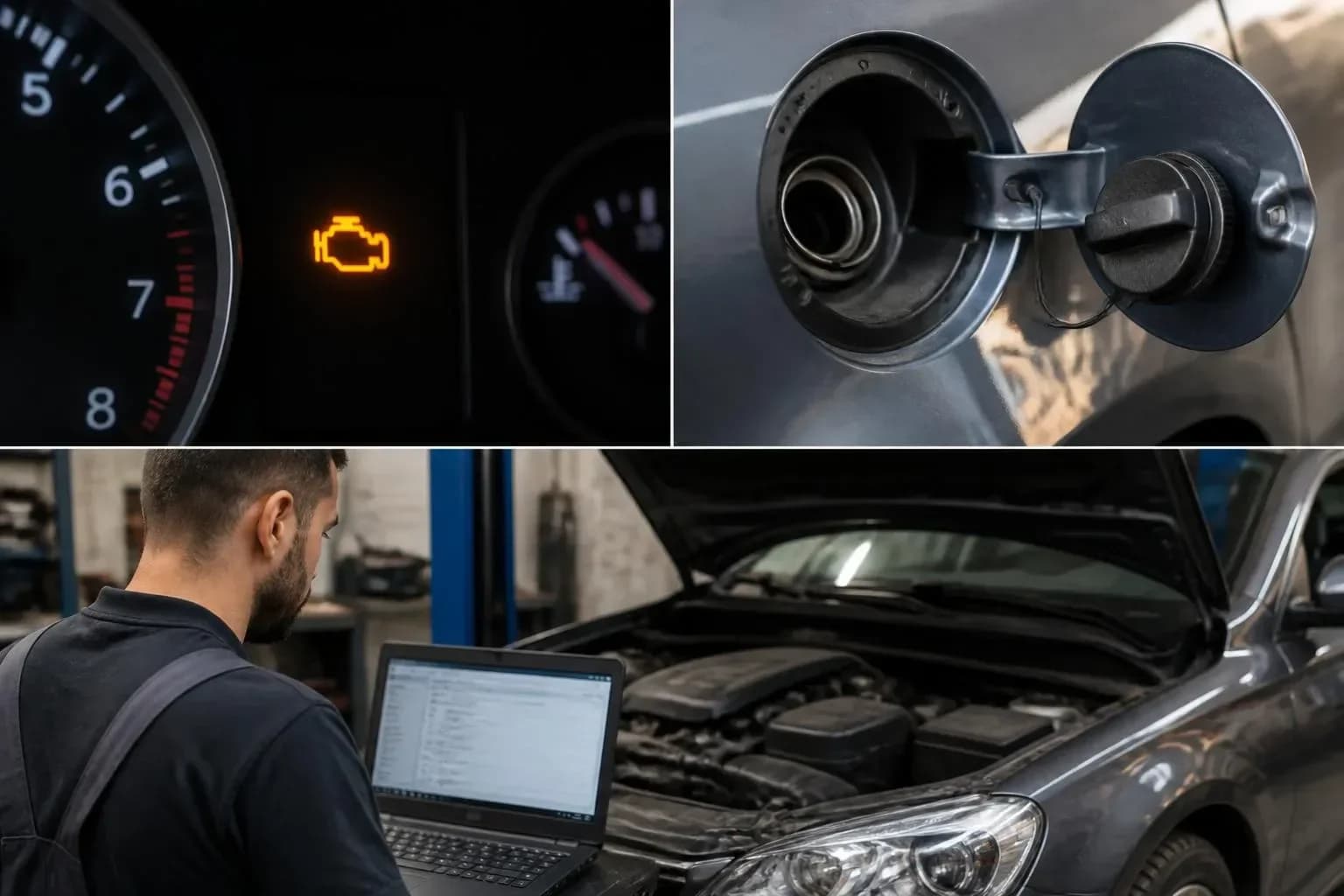
- engine warning light or a fuel system fault message
- noticeable smell at the filler cap, under the bonnet or at the rear of the car
Where the smell can come from: a fuel leak or the EVAP system
In practice it is usually one of two groups of causes. The first is a classic leak: a fuel hose, a connection, the fuel rail, around the tank, the filler cap or parts near the engine. The second is the EVAP system, which captures and controls fuel vapours.
If the EVAP system does not close the circuit, or a valve or pipe is leaking, the car can give off a smell without an obvious puddle underneath. That is why the smell alone does not identify the faulty component.
How to tell the more likely direction
If you want to book a check, a natural starting point is Engine Services. That is the right place when you need inspection of both the fuel system itself and the components responsible for fuel vapour control.
- after refuelling the smell is mainly at the filler flap or around the car
- on a warm engine the smell appears under the bonnet or in the cabin
- after a longer stop the car smells stronger than while driving
- the engine warning light comes on even though there is no visible leak
- the smell changes after opening the filler cap or after filling to full
Can you keep driving?
With a light, one-off smell after refuelling and no other symptoms, a cautious drive to a nearby workshop is sometimes possible. Treat this as an exception, not a rule. If the smell is strong, persistent, worse when stationary or accompanied by a puddle, it is safer to stop driving.
With petrol the margin for tolerance is small because the problem may be a leak from a pressurised component or heavy evaporation from a damaged hose.
What to check before visiting the workshop
1. Check whether the smell appears only after refuelling or also on a cold and on a warm engine.
2. Note whether you smell petrol in the cabin, under the bonnet or at the rear of the car.
3. Look at the ground after parking: even a small stain is an important clue.
4. Check the filler cap and the area around the fuel flap if you refuelled recently.
5. See whether the engine warning light is on or the car has other symptoms, for example rough running.
Such observations do not replace diagnostic tests but help the mechanic narrow down the area to inspect more quickly. In many cases a computer diagnostic is useful because the control unit may record faults related to EVAP, sensors or the system’s leak detection.
What the diagnostic check usually includes
With this symptom a workshop typically starts by inspecting the places where fuel or vapour leaks most often occur. They then check hoses, quick-connect fittings, the filler cap, around the tank, components near the engine and EVAP parts.
Depending on the car, the diagnostic work may also include reading fault codes, a leak test and checking the operation of the EVAP valves. In some cases it also makes sense to inspect parts related to the exhaust system if the smell might be mistaken for another fault.
Routine maintenance service is also useful as part of this check if components that lose sealing with age need inspection despite no single obvious failure.
Risks if the symptom repeats
Ignoring a petrol smell is not a good idea. With a leak you risk a larger escape of fuel, vehicle immobilisation and a fire hazard. With an EVAP fault the car may log more faults, illuminate the engine warning light and run with incorrectly controlled fuel vapour handling.
In both cases the problem usually does not resolve itself, and the longer you wait, the harder it is to pinpoint the source of the smell.
A practical decision for the driver
If the smell appeared only briefly after refuelling and quickly fades, you can monitor the car but do not ignore any recurrence. If the smell is constant, strong or noticeable in the cabin, do not plan long journeys.
In that situation it is wiser to drive to a check and not guess whether the issue is a fuel hose, the filler cap or the EVAP system.
This is the simplest step to find out where the petrol smell really comes from and whether the car is still safe to drive.