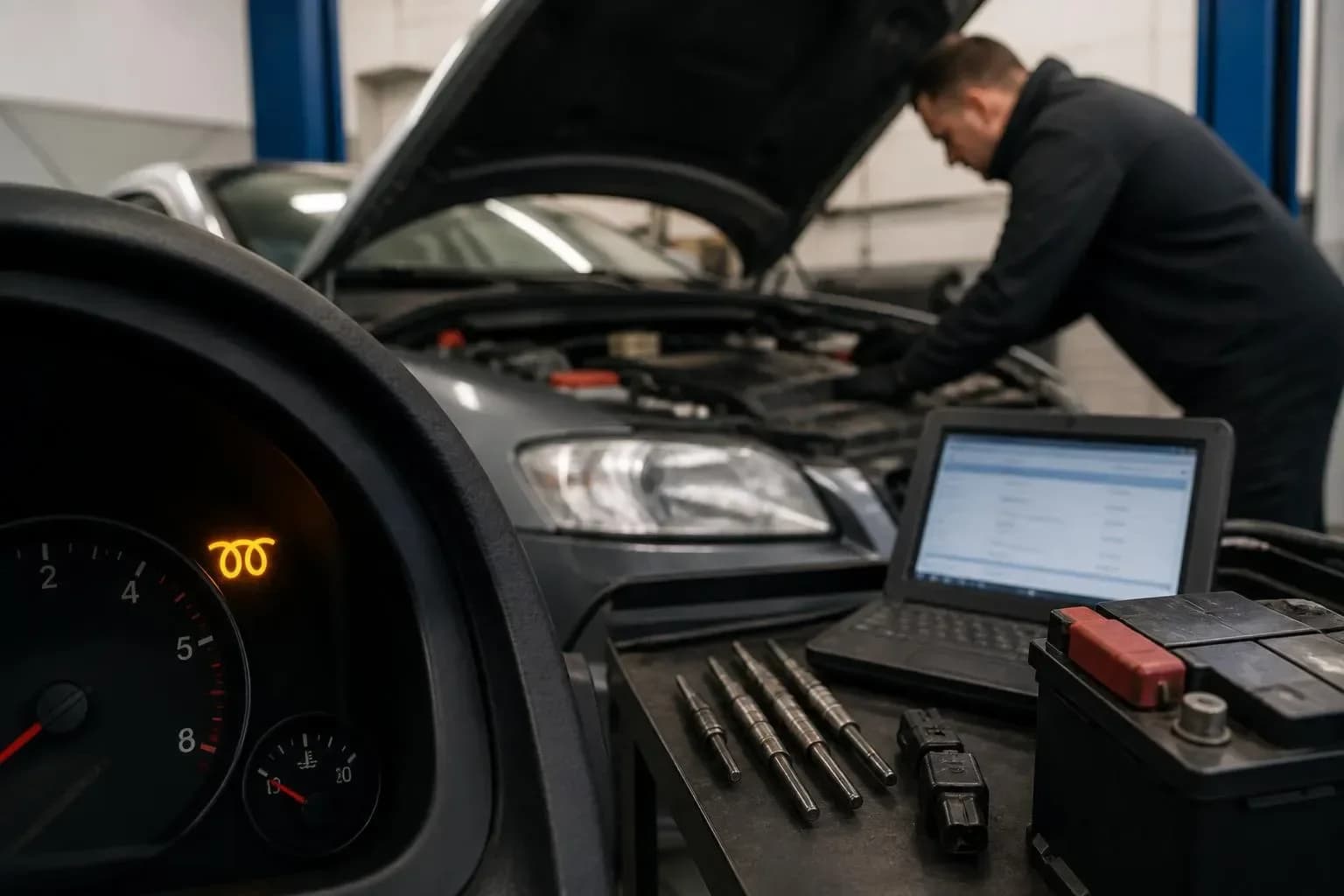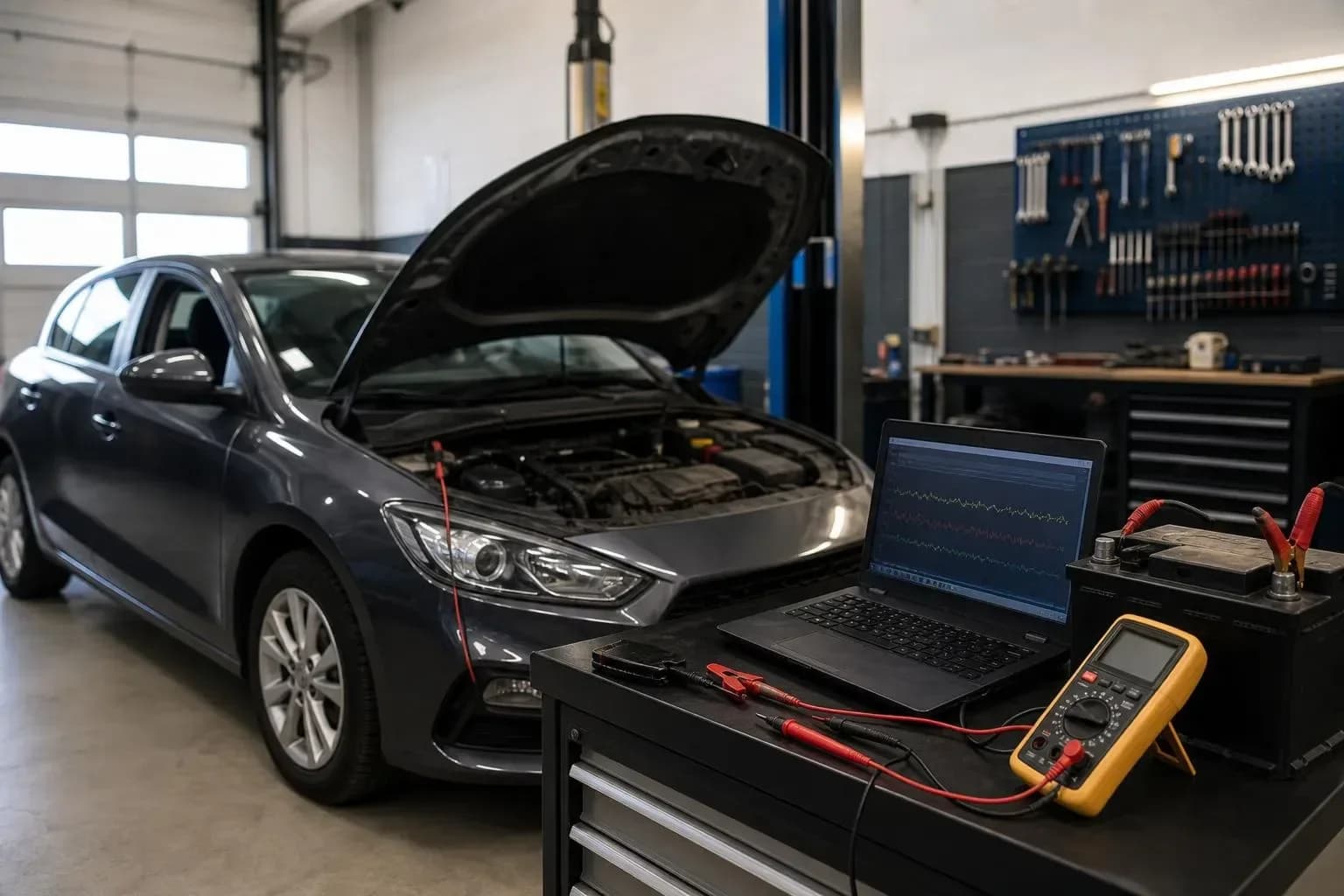
It's Monday. A few minutes past six in the morning. You're about to leave for work, take the children to school or make an important meeting. You get into the car, turn the key or press the START button.
And then everything goes silent.
Key information
You may hear only a single click. The starter motor might turn the engine with obvious effort, but the power unit does not start. Sometimes more warning lights appear on the dashboard, and sometimes nothing happens at all.
This is one of the most stressful situations almost every driver faces.
The good news is that in most cases the cause can be diagnosed relatively quickly. It does not always mean an expensive engine failure. Very often the problem is much simpler and cheaper to fix than it may seem.
In this guide we will show you where to start, what not to do and when it is worth stopping further attempts to start the car and leaving it to professionals.
A modern car is a complex set of systems working together. For the engine to start correctly, dozens of conditions must be met simultaneously.
The engine control unit checks, among other things:
battery voltage,
the immobiliser operation,
fuel pressure,
crankshaft position,
sensor operation,
condition of the ignition system,
communication between control units.
If any of these elements does not work correctly, the computer can block the possibility of starting the engine or the start-up process may fail.
This is why modern computer diagnostics are today the basic tool of every professional workshop.
Statistics show that the battery is responsible for the largest number of cases in which the car refuses to cooperate.
This most often happens:
in winter,
after a long standstill,
after leaving the lights on,
when the battery is more than 4–6 years old.
Symptoms
In such a situation it is worth checking the battery voltage or using a second vehicle and jump leads. If the problem repeats regularly, the cause may not be the battery itself but a faulty alternator responsible for charging it.
If you hear a single click after turning the key but the engine does not turn, the problem may concern the starter motor.
This is a component that does a lot of work on every trip. Over the years the brushes, solenoid or bearings wear out.
Symptoms can appear gradually. At first the car may start only on the second or third attempt, until finally the starter completely refuses to cooperate.
However, it is not worth replacing it 'blindly'. Very similar symptoms can be caused by a damaged earth strap or a poor electrical connection.
- engine turns very slowly,
- a characteristic 'ticking' can be heard,
- lights dim noticeably,
- the dashboard resets during an attempt to start.
Workshop story from e-CarService
A car arrived at our workshop whose owner was convinced an expensive starter replacement would be necessary. The symptoms pointed to that fault – the engine did not respond to the start attempt and only a single click was heard from under the bonnet.
After diagnostics it turned out that the cause was a heavily corroded earth strap. After replacing it the car started without any problems and the customer avoided unnecessary costs associated with buying a new starter.
This is an excellent example showing why professional diagnostics should always precede part replacement.
Did you know…
The first electric starter motor was used in a Cadillac in 1912. Before that drivers started engines with a crank, which was not only inconvenient but often very dangerous.
Today's starter motors perform hundreds of thousands of start cycles in their lifetime and are among the most durable components of a car's electrical system.
3. Alternator – the quiet hero of every engine start
Many drivers assume that if the car started without problems yesterday the battery must be fine. Meanwhile the cause of trouble often turns out to be the alternator, which is not charging the battery while driving.
The alternator is responsible for supplying energy to all electrical consumers and for charging the battery while driving. If its output falls, the battery gradually discharges. The driver usually does not notice this immediately – the first symptoms appear only after days or weeks.
Typical symptoms of a faulty alternator
Professional diagnostics allow you to very quickly check charging voltage and alternator performance, so you can avoid unnecessary replacement of a perfectly good battery.
More and more modern cars use advanced security systems. There is a transponder in the key that communicates with the immobiliser. If the car does not recognise the correct code, engine start will be blocked.
Symptoms can vary:
Sometimes replacing the battery in the remote or re-synchronising the key is enough. However, the problem can be on the immobiliser module or the wiring.
An engine needs three basic things: air, fuel and a spark. If the fuel pump stops working, the power unit will not receive the correct amount of fuel and will not be able to start.
Early signs of pump failure often appear before a complete breakdown:
In many cases drivers suspect an engine failure, while the real cause is much simpler.
It is a small component most drivers have never seen, yet one of the most important sensors in a modern engine.
The engine control unit must know exactly the position of the pistons. If the crankshaft position sensor stops sending correct information, the computer will not know when to trigger fuel injection and ignition.
The result?
The engine can:
This is where e-CarService wants to stand out.
We do not replace parts by trial and error.
The diagnostic process is much broader.
- the charging indicator is lit or flashes,
- lights dim while driving,
- radio resets itself,
- vehicle electrical voltage is unstable,
- the car won't start after standing still.
- the engine starts and then dies after a moment,
- a message about the key appears on the dashboard,
- the immobiliser indicator flashes,
- the car does not respond to the START button,
- the car loses power,
- the engine jerks during acceleration,
- starting takes longer than usual,
- problems appear when starting after a long standstill,
- may not start at all,
- stall while driving,
- run unevenly,
- record errors in the ECU.
Stage 1 – driver interview
The mechanic asks, among other things:
Already at this stage it is possible to narrow down the number of possible causes.
- when the problem occurred for the first time,
- whether the car used to start correctly,
- whether the fault appears only in the morning,
- whether it occurs after the engine has warmed up,
- whether warning lights were on earlier.
Stage 2 – computer diagnostics
We connect a professional diagnostic tester and check:
- stored fault codes,
- operating parameters,
- vehicle voltage,
- sensor operation,
- communication between control units.
Stage 3 – measurements
If necessary, we take measurements of voltage, fuel pressure, sensor signals and check the electrical wiring.
This gives the customer a concrete answer about what actually needs repair.
A car owner came to the workshop convinced that the fuel pump needed replacing. The car had been starting worse for several days until it finally refused to start at all.
After full diagnostics it turned out the cause was a faulty crankshaft position sensor. The fuel pump itself was fully functional.
This is another example showing that a correct diagnosis avoids costly and unnecessary repairs.
In modern cars the engine control unit analyses even several thousand parameters every second. That is why professional computer diagnostics today is much more effective than guessing the cause of a failure based on symptoms alone.
In petrol engines one common cause of starting problems is a fault in the ignition system. Worn spark plugs, damaged ignition coils or leads can make the engine crank but not start.
Typical symptoms are:
It is worth remembering that continuing to drive with a faulty ignition can damage the catalytic converter, which significantly increases repair costs.
A clogged fuel filter can restrict fuel supply to the engine. At first the car may only lose power, but over time starting problems appear. In diesels the problem may worsen in winter when fuel thickens and the filter is already very dirty.
That is why regular maintenance service is so important. Replacing filters is a small cost compared with repairing the injection system or the high-pressure pump.
In a modern car engine start depends on cooperation between many control units. The ECU, the engine control unit, must receive correct information from the immobiliser, comfort module, gearbox, sensors and wiring.
If communication is interrupted, the car may not start despite a healthy battery, starter and fuel pump.
That is why professional computer diagnostics is not just about clearing fault codes. You need to check which modules see each other and where the communication break occurs.
Not every attempt to start the car is safe. Continuing to crank the starter can make the situation worse, especially when:
In such a situation it is better to stop attempts and contact a workshop. Sometimes one sensible decision can avoid a very expensive repair.
The most important thing is not to guess. Replacing parts without diagnosis often leads to unnecessary costs and driver frustration.
- uneven engine operation,
- jerking during acceleration,
- smell of unburnt fuel,
- difficulty starting in the morning,
- flashing Check Engine light.
- the engine makes metallic noises,
- the oil warning light does not go out,
- smell of burning from under the bonnet,
- smoke appears,
- the starter turns with great difficulty,
- the car previously stalled while driving,
- many warning lights appeared on the dashboard at once.
- Discharged battery.
- Faulty starter motor.
- Alternator failure.
- Issue with the immobiliser.
- Damaged key or transponder.
- Fuel pump failure.
- Clogged fuel filter.
- Faulty crankshaft position sensor.
- Ignition system failure.
- Low fuel pressure.
- Problem with the ECU.
- Mechanical damage to the engine.
Can I check myself why the car won't start?
You can check basic things: the lights, the starter's reaction, messages on the dashboard, fuel level and the condition of the battery terminals. If the problem is not obvious, it is best to run diagnostics.
Does a discharged battery always mean replacement?
No. Sometimes charging is enough, but if the problem returns you should check the alternator, parasitic drain while parked and the condition of the battery itself.
Can you jump-start a car with cables?
Yes, but it must be done correctly. Incorrect connection of the leads can damage the vehicle's electronics.
What does it mean when the engine cranks but won't start?
Most often the problem concerns fuel, ignition, the crankshaft sensor, the immobiliser or the engine control unit.
What does a single click after turning the key mean?
It may indicate a discharged battery, a faulty starter, a poor earth connection or an issue with the electrical wiring.
- Why is the Check Engine light on?
- What does the ABS warning light mean?
- Why is the ESP light on?
- How does computer diagnostics work?
- What is OBD?
- What is the ECU?
- How to check a car before buying?