Imagine your car could say:
"I have a problem with the temperature sensor."
Key information
Or:
"I don't like the fuel pressure."
Sounds like science fiction?
Yet it's been doing exactly that for many years.
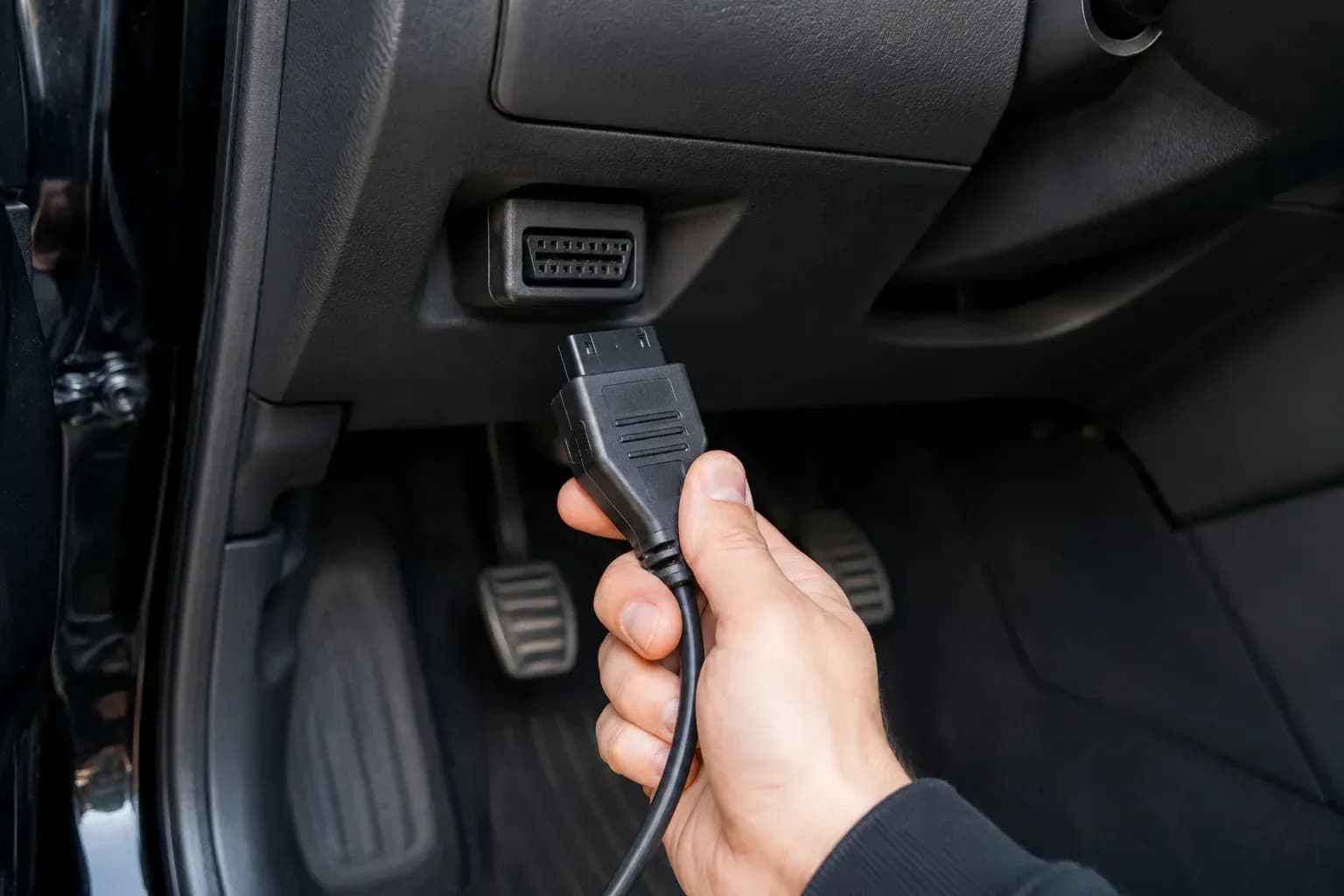
Every modern car records information about its operation and faults. You just need to connect the appropriate device to a small port usually located under the steering wheel.
That's OBD.
OBD stands for the English words:
On Board Diagnostics
which means
on-board diagnostic system.
Its job is to monitor the operation of the car's main systems and report detected faults.
It's thanks to it that the Check Engine light comes on the dashboard.
A modern OBD system can provide a huge amount of information.
Among others:
engine temperature,
fuel pressure,
engine RPM,
electrical system voltage,
lambda sensor operation,
fuel trim adjustments,
control unit errors,
DPF parameters,
AdBlue parameters,
automatic transmission data,
ABS operation,
ESP operation.
That's just the beginning.
The internet is full of ads for simple OBD devices costing a few dozen zlotys.
They can read some of the fault codes.
They cannot, however, answer the most important question:
Why did this fault appear?
It's a bit like taking a sick person's temperature and trying to make a diagnosis based on that alone.
Professional diagnostics require experience and knowledge of how individual systems work.
A diagnostic tester is the start of our work, not the end.
We read fault codes, analyse operating parameters, perform tests on actuators, compare values with the manufacturer's documentation and check whether all control units are communicating correctly.
This way we find the cause of the problem, not just its symptom.
A driver came to our service with a printed list of faults from a phone app. He was convinced that the mass airflow sensor would have to be replaced.
After a full diagnostic, it turned out the mass airflow sensor was working, and the cause was an intake hose leak. The OBD readout pointed in the direction to look, but only parameter analysis uncovered the real cause.
The first OBD standards were created in the United States in the late 1980s. Their main aim was emissions control. Today the OBD system monitors dozens of components and is one of the most important tools of modern diagnostics.
Does every car have an OBD port?
Most cars produced after 2001 (petrol) and after 2004 (diesel) use the OBD II standard.
Can I read the fault codes myself?
Yes, but interpreting the results requires knowledge. The error code alone rarely indicates the specific faulty part.
Does clearing a fault code fix the car?
No. If the cause is not removed, the fault will reappear.
- How does computer diagnostics work?
- Why is the Check Engine light on?
- What is an ECU? (coming soon)
- How does the ABS system work?
- Car won't start? Check this before calling for help.