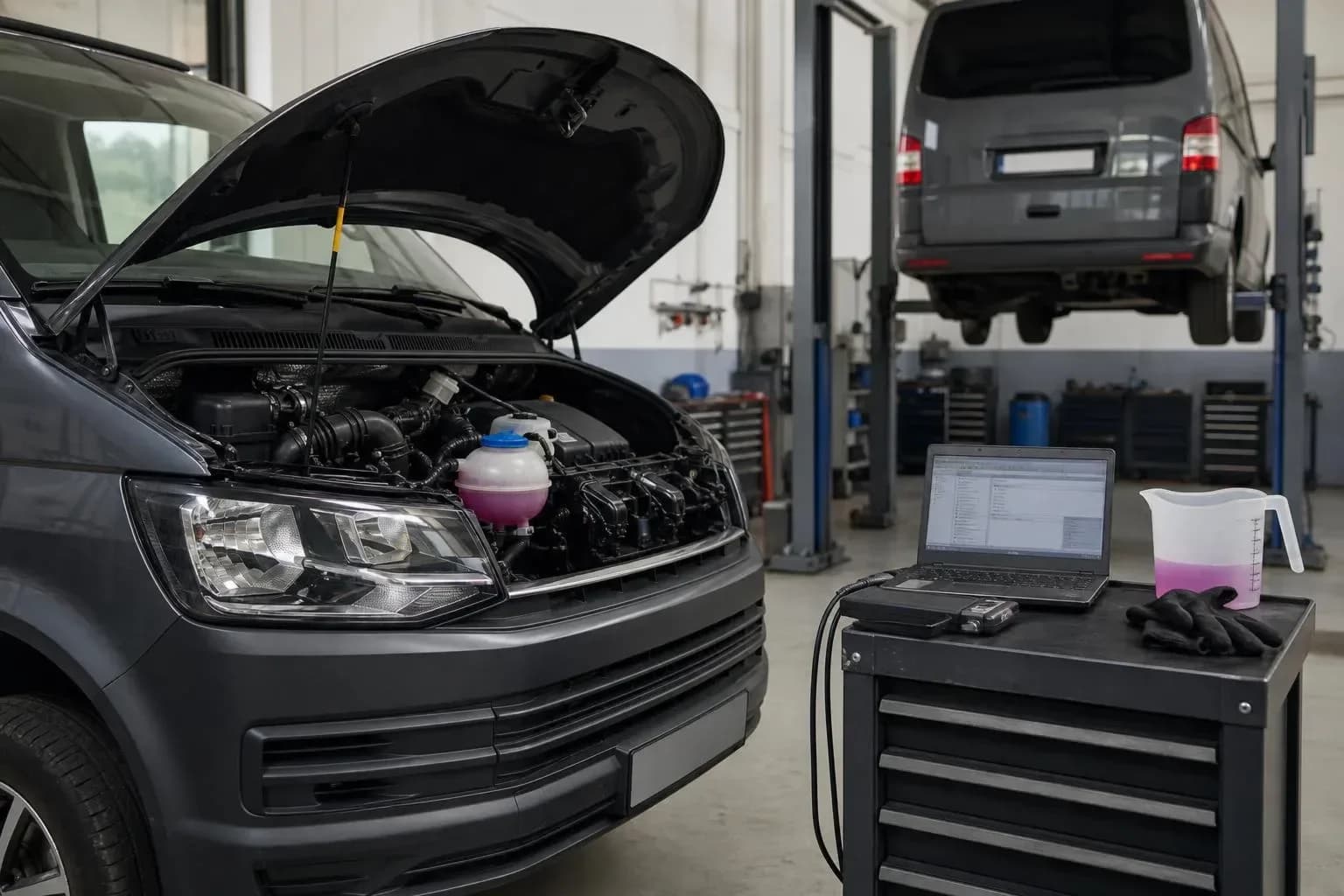
If coolant is disappearing from a VW Transporter T6 without an obvious leak, don't assume the worst, but don't ignore the symptom. Coolant can be lost via hoses, the thermostat housing, the water pump or a leak around the EGR and intake. The most important thing is to check for leaks and operating temperature before the vehicle overheats.
Can you drive if the Transporter T6 is losing coolant?
You can drive carefully to a workshop only if the coolant level is correct, the temperature remains normal and no warnings appear. If the level warning returns after topping up, the fan runs unusually long, the heater weakens or the temperature gauge rises, continuing to drive becomes risky.
If the engine overheats, stop the vehicle in a safe place and do not open the reservoir cap on a hot engine.
– The low coolant warning returns shortly after topping up
– There is no puddle under the vehicle, but the reservoir gradually empties
– Engine temperature rises in traffic, under load or on the road
– The radiator fan runs for a long time after switching off the vehicle or switches on more often than usual
– White smoke appears, there is a sweet smell, loss of power or a Check Engine warning
– Heating in the cabin weakens even though the engine should be warm
Why does coolant disappear when the area under the vehicle is dry?
A dry patch under the vehicle does not mean the system is sealed. A leak can occur only under pressure, evaporate on a hot engine or flow to a place where it does not drip directly onto the ground.
With the Transporter T6 it's worth checking the cooling system cold and hot, because a small leak in a hose, clamp, spigot, thermostat housing or water pump can show up only while driving.
A typical driver mistake is topping up coolant for several weeks without finding the cause. That hides the symptom but does not fix the problem. A VW workshop should first establish whether coolant is escaping externally or entering a part of the system where it should not be. Only then does it make sense to decide which component to repair.
EGR, thermostat or water pump: what causes similar symptoms?
EGR (exhaust gas recirculation), the thermostat and the water pump can produce a similar effect for the driver: you have to keep topping up coolant and temperature behaves differently than usual. The thermostat housing or its seal can leak locally.
The water pump can leak or fail to provide correct circulation. A leak in the EGR cooler can link cooling-system symptoms with engine behaviour and exhaust emissions.
If loss of coolant is accompanied by loss of power, smoke, rough running, engine management errors or problems with DPF (diesel particulate filter) regeneration, you need to look beyond the expansion tank. Diagnostics then includes the cooling system, EGR and engine ancillaries, and, when emission symptoms appear, the DPF area as well.
A service related to the EGR cooler helps check this direction without risky workarounds and without guessing based only on a forum description.
What to check before visiting the workshop?
Before the visit it is worth gathering symptoms, but do not dismantle the vehicle yourself. Good information from the driver shortens the diagnostic path: the mechanic will know whether to look for a leak after parking, after warming up, under load or on a specific route.
1. Check the coolant level only on a cold engine and note how much you had to add
2. See whether there are deposits or dampness around the reservoir, hoses and visible spigots
3. Note when the warning appears: after a night, after a trip, in traffic or under higher load
4. Observe the temperature and heater performance, but do not continue driving if overheating occurs
5. Do not add sealants to the system, as they can hinder diagnostics and worsen flow
6. Tell the workshop whether there is white smoke, loss of power, frequent DPF regeneration or a Check Engine warning
What does sensible diagnostics of the cooling system and DPF/EGR look like?
Sensible diagnostics start with confirming the symptom, not replacing the most expensive part. In practice a garage checks the level and condition of the coolant, signs of leaks, fan operation, pressure tightness and temperature behaviour.
At the same time, computer diagnostics read fault codes and parameters that may indicate a problem with the EGR, temperature sensors, fan control or engine operation under load.
If symptoms point towards exhaust emissions, it is worth combining cooling checks with a service for the DPF, EGR, AdBlue (diesel exhaust fluid) and the exhaust system. That does not automatically mean an expensive repair.
The aim is to check whether the coolant loss is related to the EGR or intake and whether the engine control unit (ECU) is logging faults that explain loss of power, smoke or abnormal fan behaviour.
When not to postpone repair of the Transporter T6?
Do not delay a visit if top-ups become regular, temperature rises or the vehicle operates differently than usual. The Transporter T6 is often a working vehicle, so an apparently small leak can quickly stop the vehicle at the least convenient moment.
The safest next step is a leak check, checking engine parameters and only then deciding whether the thermostat, pump, hoses, EGR or another component is at fault.
Proper diagnostics of the cooling system and DPF/EGR reduces random part replacement. The driver gets a clear answer on whether it is safe to keep driving, what needs immediate repair and what can be planned after confirming the cause.