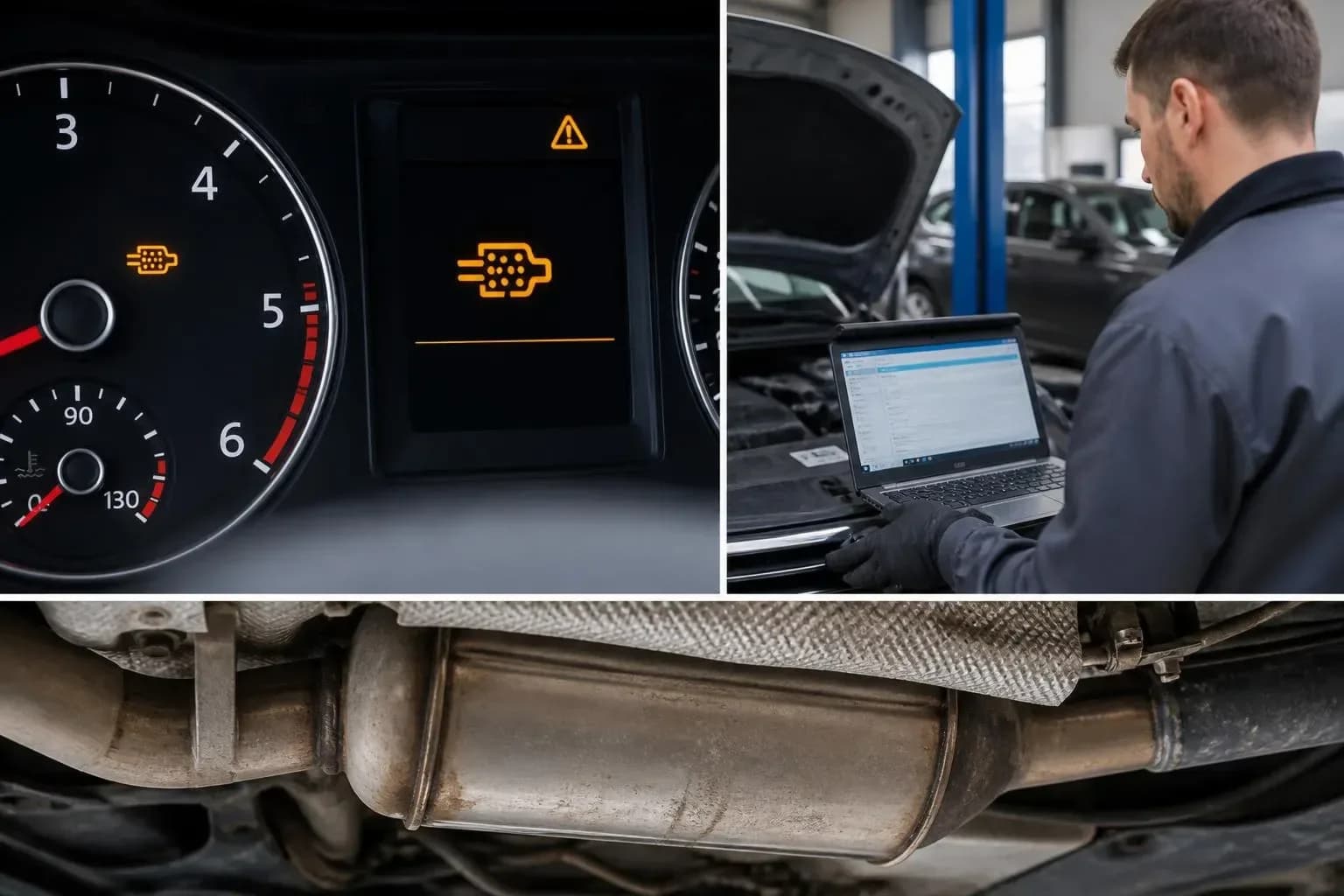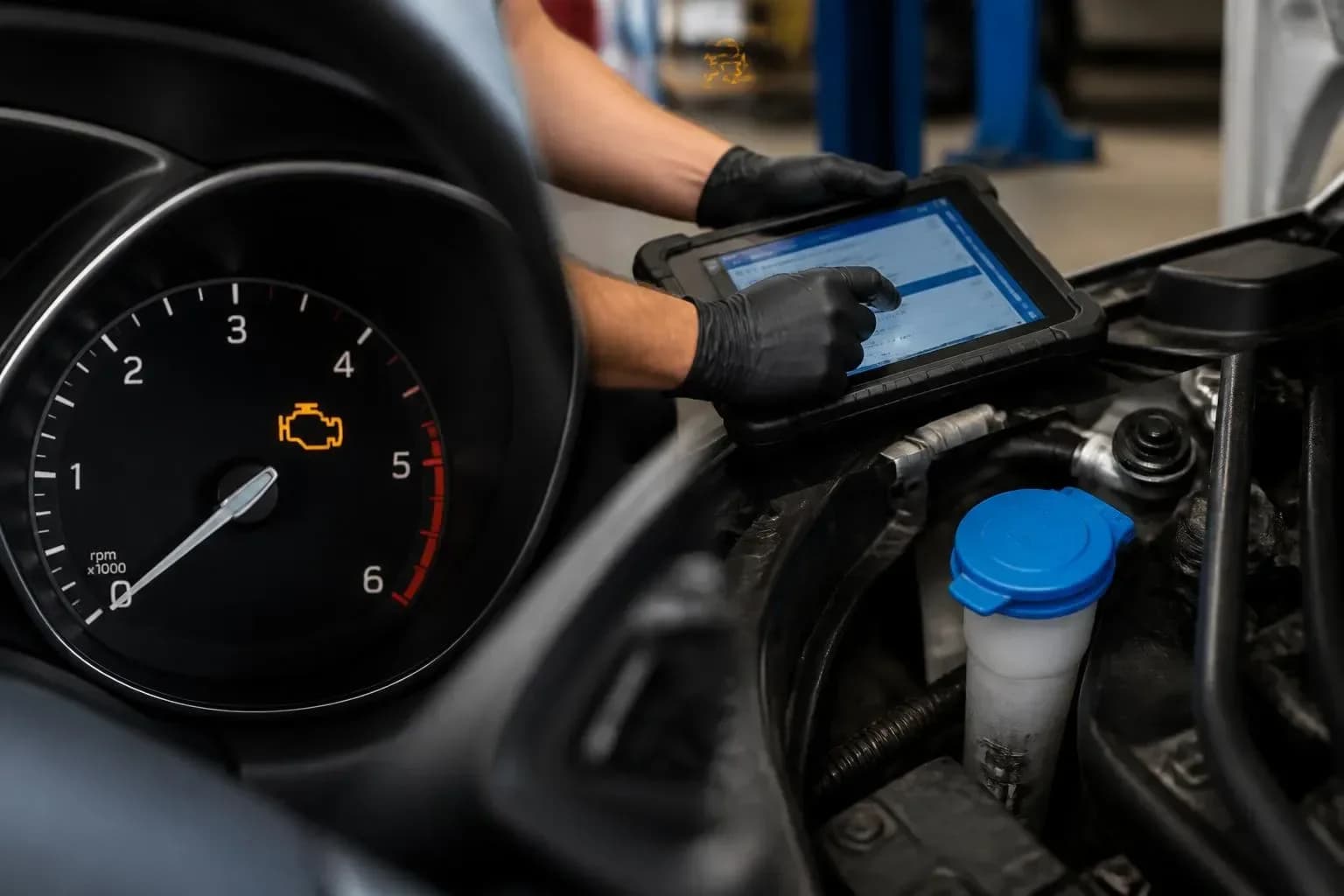
The DPF warning light comes on in the morning, then the car accelerates less strongly? The cause could be difficulty regenerating the filter, a problem with the EGR, a sensor or another system component, so the symptom alone is not enough to identify the fault. If the warning returns, limp mode is activated or a starting restriction message appears, do not put off diagnostics and follow the instructions for that specific car.
This guide explains the differences between typical DPF, EGR and AdBlue warning signs without treating them as a definitive diagnosis. You will also learn what to note before your visit, what a system check involves and when cautious driving is no longer a sensible choice.
How to interpret DPF, EGR and AdBlue symptoms
A warning light or message describes what the control system has detected, but it does not always identify the failed component. The same applies to loss of power, uneven running and increased fuel consumption: symptoms associated with these systems can overlap, and their cause needs to be confirmed in the car.
It helps to observe things in order. Write down the exact wording of the message, check whether the warning light is on continuously or flashing, and note whether the engine is behaving differently. Do not rely on the warning light colour alone or on general advice found for another model. The handbook for your car takes precedence.
In practice, a set of observations is more useful than guesswork: when the message appeared, whether the car had mainly been used for short journeys beforehand, whether the warning disappeared and returned, and whether a message about restarting appears after the engine is switched off. These details can help the garage narrow down its checks, but they do not replace measurements.
- DPF: note any message relating to the filter and whether the warning returns or flashes.
- EGR: uneven running, juddering or weaker acceleration may be consistent with a fault, but do not confirm one on their own.
- AdBlue and SCR: check whether the car reports a low fluid level, an emissions fault or a restriction on restarting.
DPF: short journeys can make regeneration difficult
The diesel particulate filter (DPF) traps soot from the exhaust gases. The control unit may periodically raise the exhaust gas temperature to burn it off; this process is called regeneration. How it works depends on the car's design and driving conditions, so the warning light may not come on in the same way in every model.
Frequent short journeys, driving at low speeds or low exhaust gas temperatures can make automatic regeneration difficult. If a warning appears after a period of this kind of use, it is a useful clue, not proof that the filter simply needs to be burned off. The handbook for the specific vehicle explains whether and how the driver should respond to a given message.
A flashing or recurring DPF warning light should be taken seriously. Driving for a long time with a flashing warning can damage the system and increase fuel consumption. Repeated attempts to trigger regeneration do not replace checking the cause, especially if the message does not go away.
Regeneration burns soot, but ash remains in the filter. A DPF message therefore does not automatically mean that running a regeneration will be enough. Sensor readings and their pipes may also be relevant: the differential pressure sensor compares exhaust pressure before and after the filter, and pipes blocked with soot can give a false indication of the filter load. For more about a warning light coming on alongside a loss of power, see the guide to the DPF warning light and loss of power.
- Do not attempt a forced regeneration yourself. The exhaust system reaches very high temperatures during regeneration.
- Do not park the car over flammable materials if regeneration may be taking place.
- Do not assume that every regeneration is indicated by the same warning light or that it can be safely interrupted. What to do depends on the car's handbook.
EGR: uneven running does not prove the valve has failed
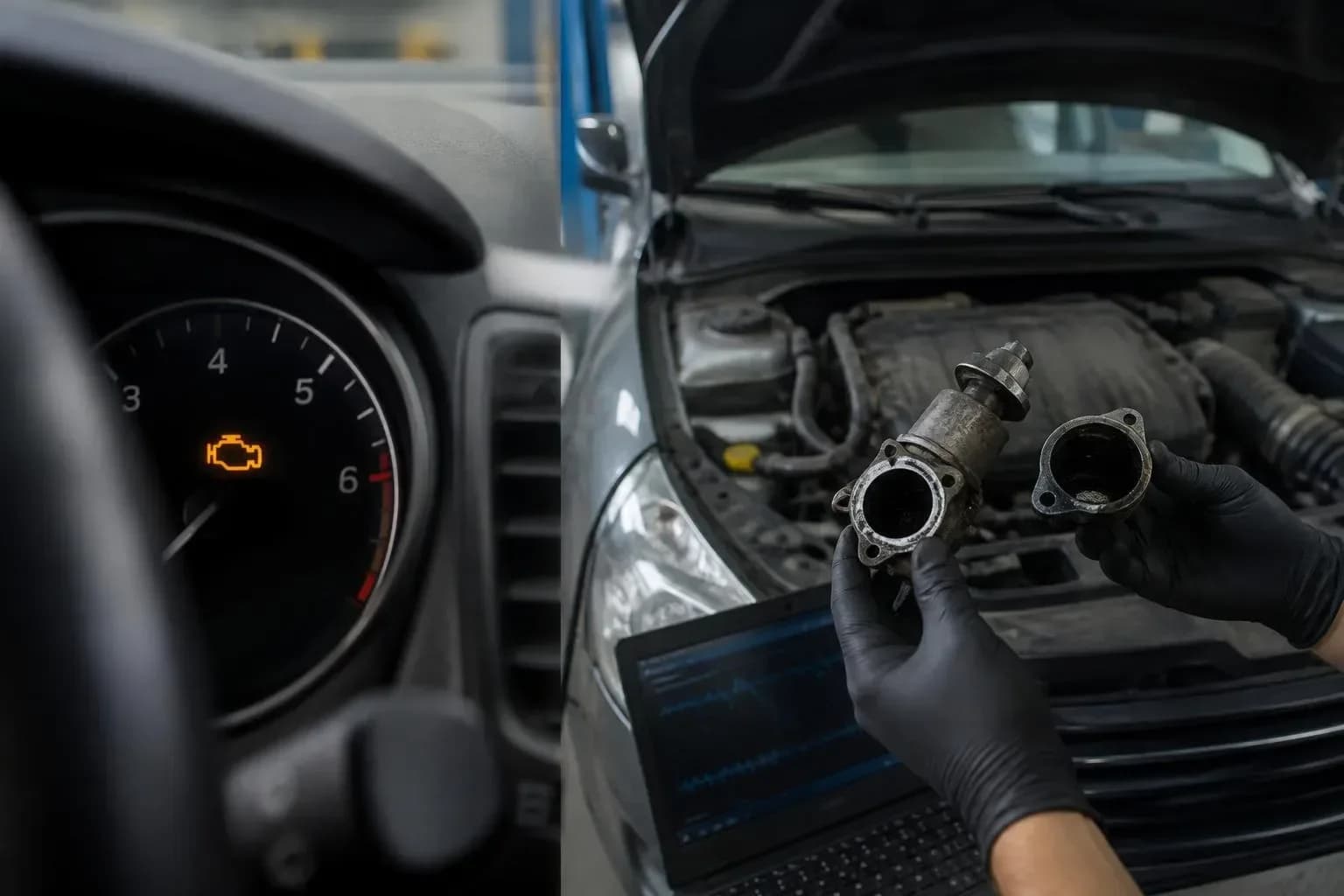
The EGR system directs a controlled portion of the exhaust gases back into the intake, helping to reduce nitrogen oxide emissions. A fault may be associated with an engine warning light, black smoke, uneven idling, weaker acceleration or juddering. However, none of these symptoms on its own confirms that the EGR valve has failed.
Possible causes include a jammed or permanently open valve, deposits, a control problem, vacuum pipes or an electrical fault. What is likely depends on the system design and the condition of the engine. Deposits in the EGR system may also result from another problem, so cleaning or replacing the valve without checking the cause may not resolve the fault.
If the engine warning light is on and the engine is running unevenly, the problem needs to be distinguished from a fault in the intake or other components. A separate guide explains how to approach a situation involving an engine warning light and uneven running. Do not automatically attribute a loss of coolant to the EGR cooler; one symptom alone is not enough to identify the cause. For more about possible causes of this combination of symptoms, see the guide to coolant loss and the smell of exhaust fumes.
AdBlue and SCR: the message may relate to starting
AdBlue is a fluid used by the SCR system, which doses it into the exhaust to reduce emissions. A low fluid level warning and an emissions system fault warning do not necessarily indicate the same problem. Read the full message rather than relying only on the word “AdBlue”.
In some cars, a warning may indicate that restarting will be restricted after the engine is switched off. Check whether the car gives a deadline or remaining distance, and follow the instructions for that vehicle. There is no confirmed distance that can be treated as common to all makes and models.
If the message does not disappear after topping up the fluid, do not immediately assume that too little was added or that the fault has definitely persisted. The exact wording of the warning and the manufacturer's guidance matter, and the system may need diagnostics. Treat a starting restriction message as urgent, because it may not be possible to restart the engine after switching it off.
Detailed guidance on what to do when a fault message and starting restriction appear is provided in the guide to AdBlue messages. If the problem specifically concerns a Sprinter, a separate article covers AdBlue and failure to start in the Sprinter. Do not apply guidance for one model to other cars.
When to limit driving and when to seek help without delay
There is no single criterion that determines for every car whether you must stop driving immediately. Take account of the wording and colour of the warning, how the engine is behaving and the manufacturer's instructions. If the handbook says to stop or gives specific instructions, follow them instead of general advice.
If the car has entered limp mode, has clearly lost power, the DPF warning has returned or a starting restriction message has appeared, contact a garage as soon as possible. Whether you can drive there depends on the message and the handbook for that specific car. Do not plan a longer journey on the assumption that the car is “still going”.
If the engine is behaving differently from usual and the message does not clearly say what to do, do not try to force regeneration or clear the warning without establishing the cause. Limit use of the car to situations where the handbook and its behaviour indicate that it is safe to continue, and agree the next steps with a garage.
For example, a driver mainly made short journeys, then saw a DPF warning, and after further trips the warning returned and the car lost power. Short journeys are a relevant clue, but they do not confirm that the filter is the only cause. The sensible next step is to check the message in the handbook and arrange diagnostics rather than repeatedly attempting to burn off the soot.
What to note before visiting a garage
Drivers do not need to know fault codes or understand how individual sensors work. However, they can provide information that helps recreate the situation. Write down the exact wording of the message as displayed by the car, and note whether the warning light flashes, stays on, disappears or returns.
Describe what was happening with the car before the warning appeared: whether there was a loss of power, juddering, uneven running or increased fuel consumption, and whether the car was mainly used for short journeys. If the message gives a starting restriction, keep its exact wording and any deadline or distance shown by the car. Do not add your own calculation or prediction.
The sequence of events is also useful: when the first warning appeared, whether the car was stopped or AdBlue was added, and whether the message changed afterwards. Do not delete the recorded information or use it to decide by yourself which part needs replacing. The aim is to pass on the facts, not to make a diagnosis.
You can prepare a short list of symptoms and questions before your visit. If you want to understand more about reading data from a car, the article on computer diagnostics in practice explains how it works. Reading a message alone does not determine the scope of the repair.
- Write down the exact wording of the message and how the warning light behaves.
- Describe when the symptoms occur and how the engine's behaviour changes.
- Say whether the car is mainly used for short journeys and whether the warning returns.
- Mention any AdBlue top-up or other actions taken, without judging how effective they were.
How a garage checks the system before carrying out repairs
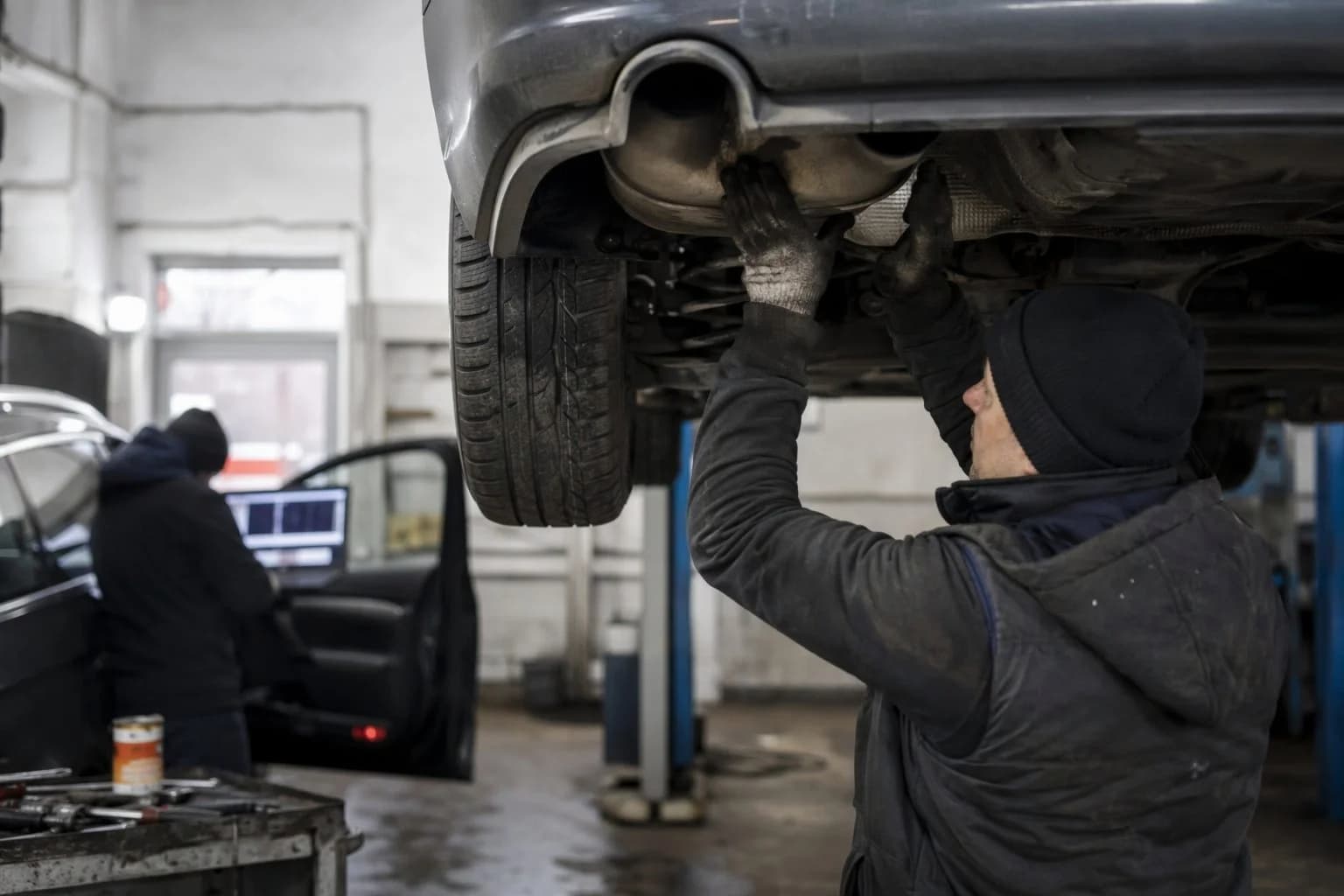
Diagnostics start with reading the messages and stored fault codes. The garage then analyses the operating parameters of the relevant system and, if needed, checks the sensors and their pipes. A fault code is a clue for further checks, not an automatic instruction to replace a part.
If an EGR fault is suspected, the garage may check operating parameters and run an actuator test if the system supports one. With the DPF, the garage needs to assess, among other things, whether the sensor readings and pipes accurately reflect the filter's condition. It also checks whether regeneration is possible and safe for that car.
For an SCR warning, the mechanic needs to consider the exact message and the vehicle data, because a low AdBlue level and an emissions fault do not necessarily mean the same thing. The checks should establish whether the problem relates to the system itself, its controls, sensors or another component. It is not possible to determine this reliably without checking the vehicle.
Replacing or cleaning parts without establishing the cause may not resolve the problem. This is particularly relevant to the EGR system, where deposits may result from another fault, and to the DPF, where a warning does not always mean that regeneration will be enough. Diagnostics of the exhaust after-treatment system may include , and the checks should be based on the symptoms and data for the specific car.
What to ask the garage before agreeing to repairs
Before agreeing to replacement, cleaning or regeneration, ask what check results justify the proposed work. You do not need to assess the measurements yourself, but you can check whether the garage links the symptom to a specific result and explains what still needs to be verified.
Ask:
1. What exact message and stored fault codes were found? Ask for a description and an explanation of what they confirm and what they do not establish.
2. Which parameters or components were checked, including sensors and their pipes? Ask for the measurement results or a brief explanation of the data used to reach the diagnosis.
3. Why are you recommending regeneration, cleaning or replacement? The answer should identify the cause and explain whether possible problems that could have led to the symptom were checked.
4. What work will be carried out and what will be checked afterwards? Agree the scope before work starts and ask how the garage will confirm the result.
Agree the scope of work and ask about the cost before work starts. At eCarService, the cause is diagnosed first and only then repaired; the scope of work is agreed with the customer before the repair, and the vehicle's service history is documented. The next practical step is to note the message and symptoms, then arrange a check of the . Online booking is available around the clock.