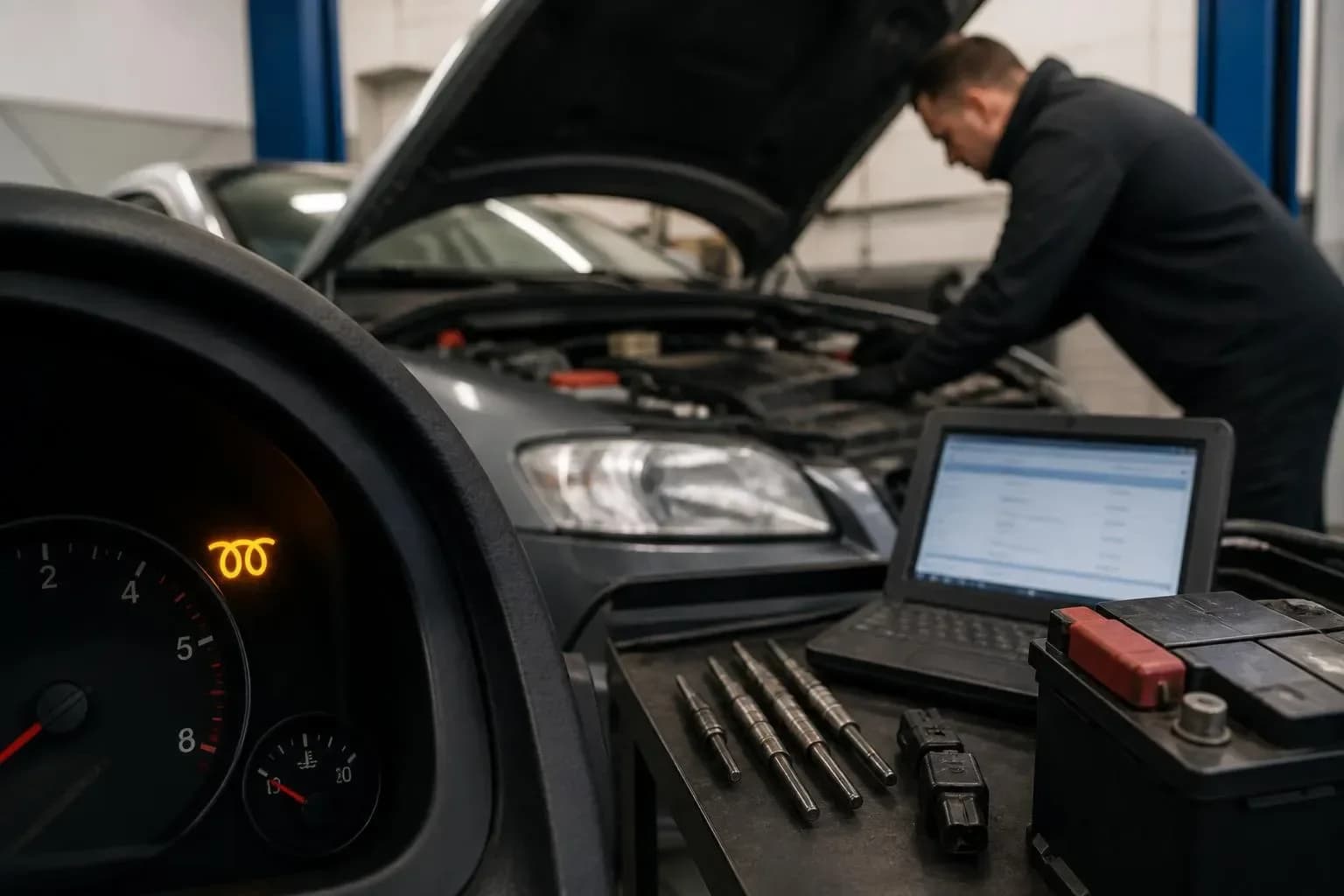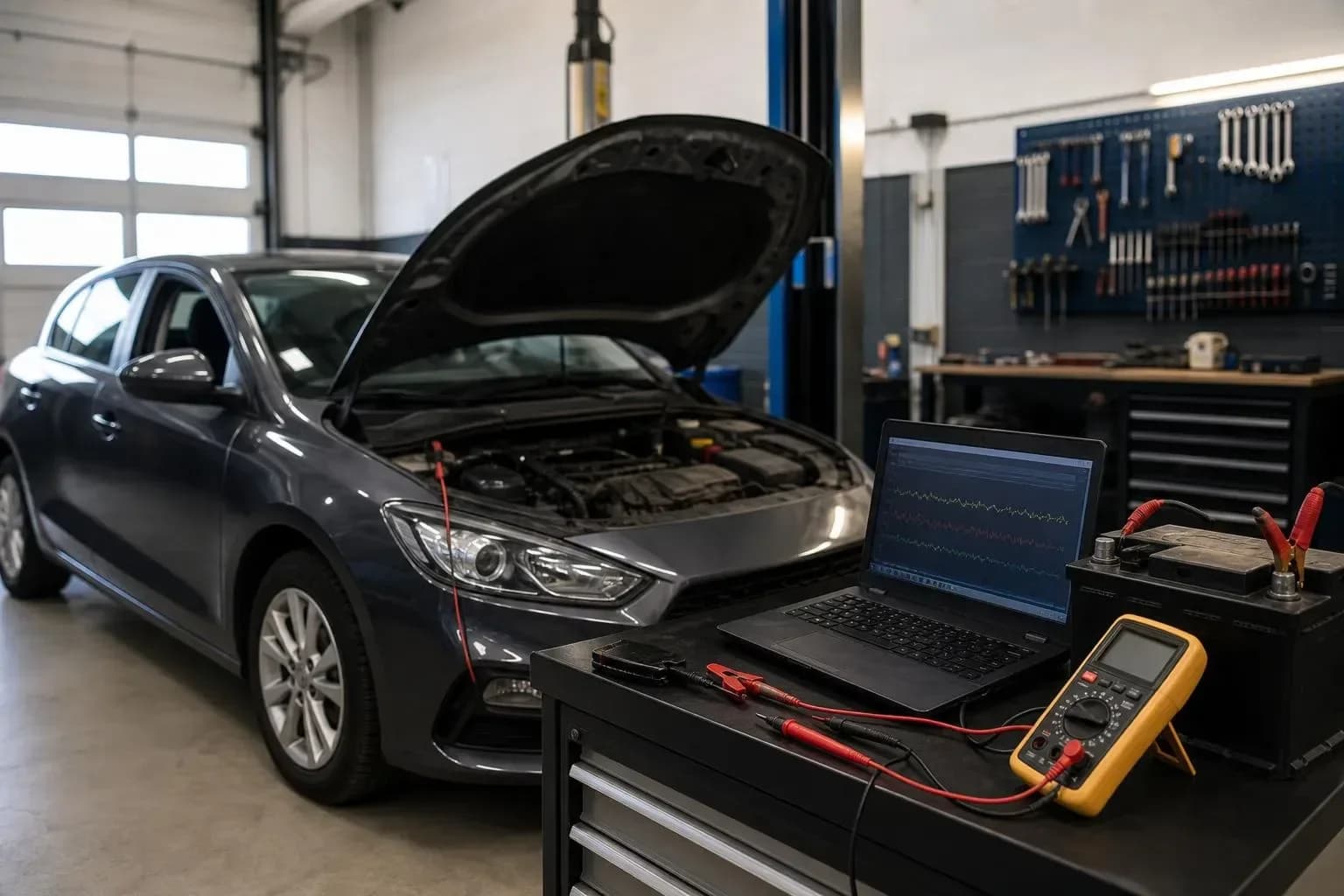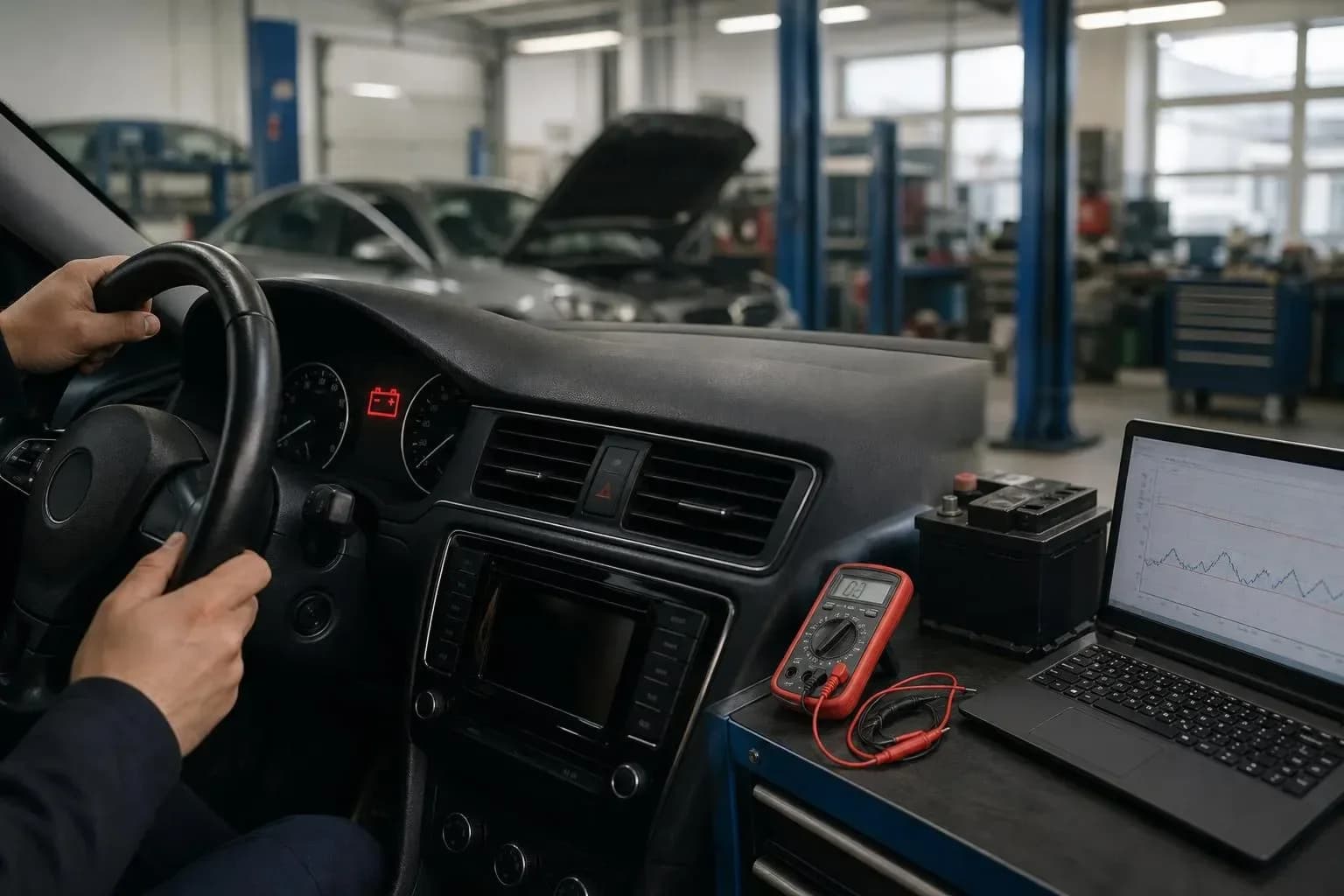
A battery warning light on while driving usually indicates a charging problem rather than a worn battery. The car may still run but uses stored battery energy. When voltage falls, systems can switch off and the engine may stall and fail to restart.
What does the battery warning light mean while driving?
The battery warning light while driving means the charging system is not working correctly or a control unit detects too low voltage. In practice, the energy needed for ignition, lights, pumps, fans and electronics is not being replenished as it should.
In a healthy car the light should go out after the engine starts. If it stays on, flashes or only comes on after a few minutes of driving, treat it seriously. The battery then acts only as an energy store, not as a continuous power source for the car.
Is the battery, alternator or belt to blame?
Most often the cause is the alternator, the accessory drive belt, electrical connections or the voltage regulator, and the battery itself is only a consequence. A weak battery more often shows symptoms at starting, for example slow starter cranking or silence when turning the key.
The alternator is responsible for charging while the engine runs. If it stops working, the car runs only on reserve energy. A broken or slipping belt can also affect other driven accessories, depending on the vehicle’s design. A loose battery terminal, corroded ground connection or a damaged cable can also be the problem.
Did you know that in modern cars the charging voltage is not always constant? Alternator control may depend on engine load, temperature and power demand. For that reason, just watching the warning light is not enough to identify a specific component. Voltage measurements and assessing the system under load are required.
What symptoms indicate loss of charging?
Loss of charging usually produces several symptoms at once, especially when voltage in the electrical system drops. The more consumers are switched on, the faster the battery discharges.
Some of these symptoms may look like an electronic fault, but the root cause can be too low voltage. That is why a good workshop does not start by replacing random modules. First the basics are checked: battery, alternator, cables, ground connections and voltage behaviour with the engine running.
- battery warning light stays on or lights when you accelerate
- lights dim, flicker or dashboard illumination changes brightness
- messages about ABS, ESP, power steering or other systems appear
- radio, ventilation, heated windscreen or multimedia behave erratically
- engine begins to run roughly and after stalling the car won’t restart
- you hear belt squeal, smell burnt rubber or notice unusual noise near accessories
Can you continue driving with the battery light on?
With the battery light on you can sometimes drive cautiously to a safe place, but you should not plan a longer journey. If the car is losing charging, driving time depends on battery condition and the number of switched-on consumers, and the end can come with little warning.
It is sensible to reduce electrical load: switch off heated screens, seat heaters, extra lighting and multimedia where driving conditions allow. Do not switch off lights required by law or systems needed for safe driving.
If additional warning lights appear, power steering assist is lost, the engine runs erratically or you smell burning, stop the car in a safe place.
Particular caution is needed if the light came on together with belt squeal or rising engine temperature. In some designs a problem with the accessory belt can quickly lead to further trouble. Continuing to drive then can result not only in a discharged battery but also in a more serious repair.
What can you safely check yourself after stopping the car?
After stopping the car you can safely check only basic things, without dismantling the electrical system or doing risky tests with the engine running. The aim is to assess whether you can call for help, drive to a garage or better leave the car where it is.
Check whether the battery terminals are clearly loose, whether a cable is visibly damaged and whether the accessory drive belt is in place. If you have a meter and know how to use it, the battery voltage with the engine running can indicate whether charging is happening at all.
Do not touch rotating parts and do not disconnect battery leads while the engine is running.
It is also worth recalling what happened earlier. Has the car been harder to start lately? Does the light still appear after the battery was replaced? Does the problem occur after rain, on rough roads or after switching on many consumers? Such information helps narrow down the cause during electrical diagnostics.
When is a charging-system diagnosis needed?
A charging-system diagnosis is needed whenever the light returns, stays on after starting or appears with other electrical symptoms. Simply recharging or replacing the battery may help only temporarily if the alternator or wiring still operate incorrectly.
A workshop checks not only the battery condition but also charging voltage, voltage drops on cables, ground connections, alternator operation and stored fault codes in control modules.
Computer diagnostics can be important because modern vehicle electronics can log events such as low voltage, power interruptions or problems controlling charging.
If the battery warning light came on while driving, first ensure a safe stop or reach the nearest reasonable place. Then don’t guess based on a single light. Checking the charging system in a service helps distinguish a worn battery from a failure of the alternator, belt, wiring or control.