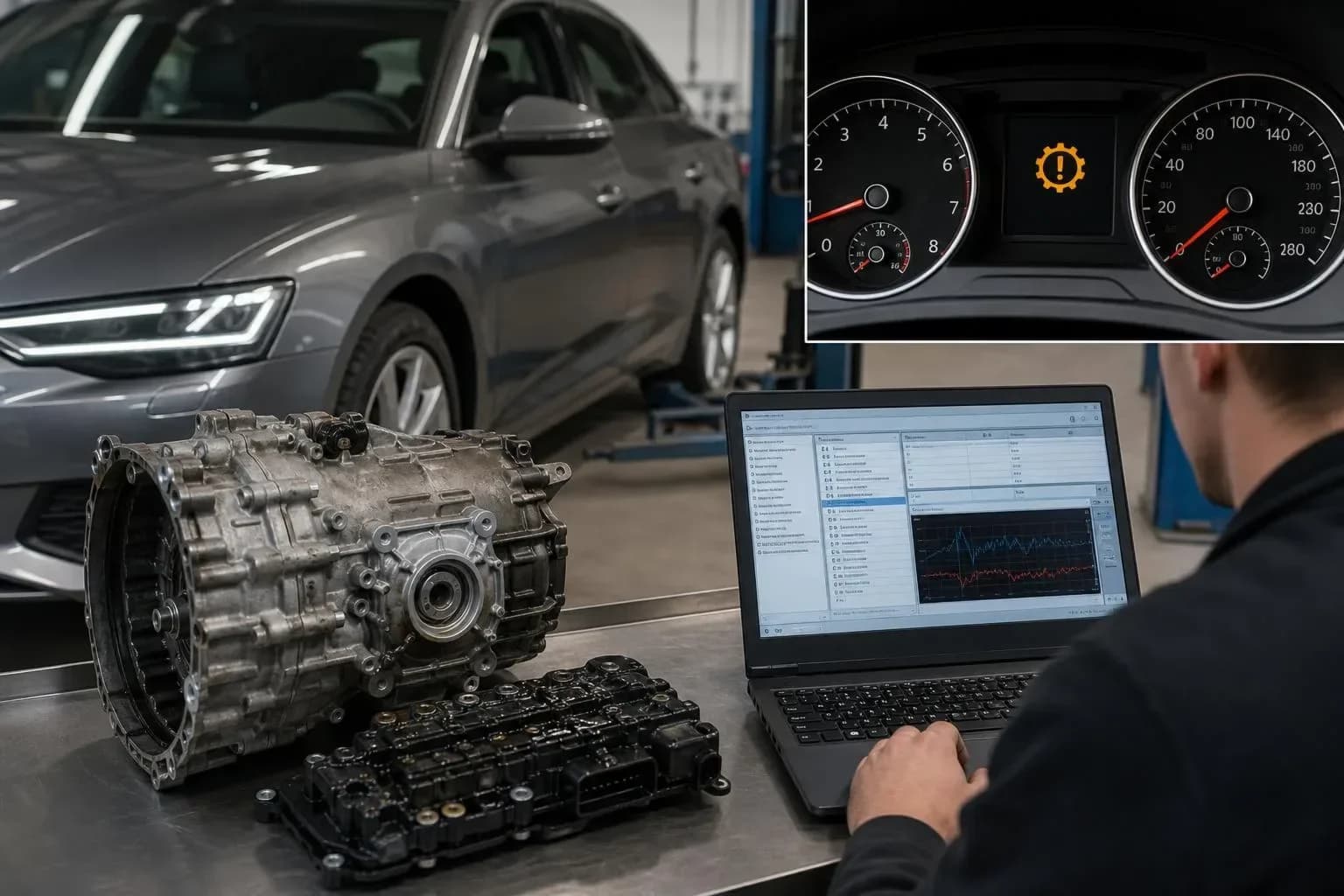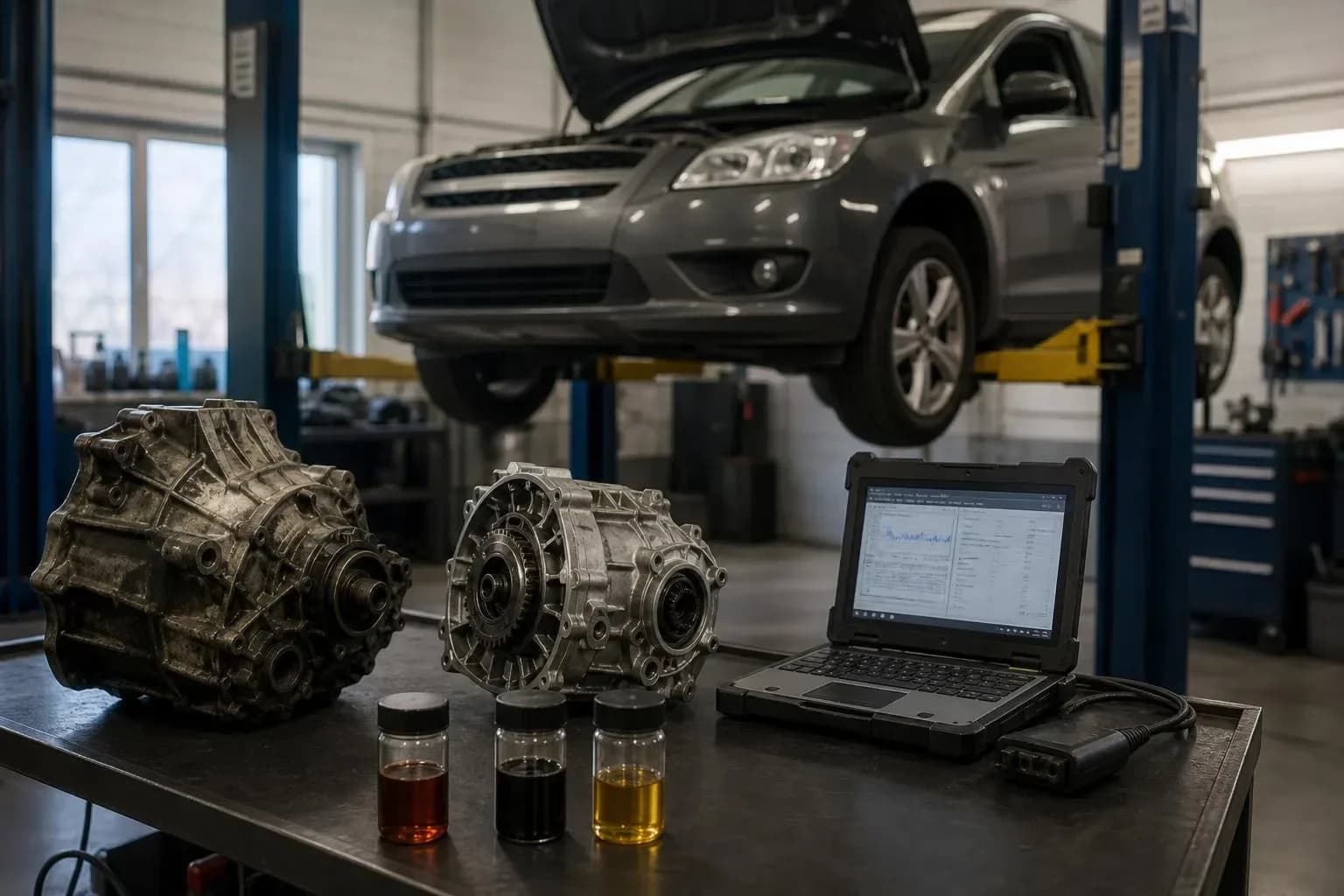
If you wonder whether it’s already time for a transmission oil service and whether you can still drive, the answer is: first you must establish if the symptoms fit an oil problem or rather a hydraulic/electrical fault. Delayed shifts, jerking and “different” behaviour can occur, but just as often the cause is control and sensors.
In a gearbox the oil is not “just a lubricant”. It transmits torque (in an automatic), operates the hydraulic system, cools components and affects the condition of the friction parts. When its properties degrade, the behaviour of the whole transmission changes. At the same time, replacing the oil does not always fix the root cause — so treat the matter as a diagnostic process, not a guess.
How do you know the problem may be the transmission oil and not something else?
Transmission oils degrade gradually and symptoms often build up “in the background”. Pay attention to whether the gearbox behaviour is repeatable and depends on temperature or driving style. If symptoms appear over time, not immediately after an event (for example
after a long stop), an oil service can be a sensible first diagnostic step — but only if there are no signs of a failure.
Note: similar symptoms can also come from electronics (sensors, response times), hydraulics (valves/pressure) or wear of friction parts. Therefore, before deciding, check what the control unit reports and how the car behaves in specific conditions.
- Oil (or its condition) most often suggests itself with symptoms such as: – jerking when engaging a gear or when changing ranges – delayed gearbox reaction to lever movement (forward/back, when selecting D↔R) – “fluctuating” torque: sometimes it shifts normally, other times with a noticeable hesitation – worsened comfort on a warmed-up transmission (for example after reaching town) – increased noise or a noticeable rise in vibrations during gearbox operation
Can you keep driving, or should you stop?
This is the key question. If the gearbox is working unreliably, risk rises with how strong and how often it jerks or delays shifts. The goal is to avoid a situation where mechanical or hydraulic damage worsens through further use.
In practice, the safest approach is to drive only as necessary (to the nearest workshop), avoiding dynamic acceleration and long runs under heavy load. Instead of checking “has it cleared up yet”, focus on gathering information for diagnostics.
- What usually means you can drive carefully but shouldn’t delay: – jerking is light and occasional, not worsening while driving – the gearbox changes gears, but with a noticeable delay – no additional error messages on the dash and the car still drives “albeit worse” What signals “don’t wait” and suggest limiting driving: – strong jerks on every shift – increasing delay over time (operation worsens after additional kilometres) – limp mode, flashing gearbox lights or warning messages – slippage: revs rise but speed increases poorly – unusual noises (rubbing, whining) accompanying shifts
What to check before deciding on an oil service for the transmission?
Good preparation shortens diagnostic time. In the workshop it matters not only that it “jerks”, but also when and in what conditions. Before doing an oil service, collect data that will help distinguish an oil issue from a control fault or wear.
What helps particularly in the decision is the presence of fault codes stored by the control units. Simply clearing a code without further diagnosis can be misleading: the symptom returns and without explanation it’s harder to identify the source.
- A quick checklist you can do yourself or note for the symptom description: 1) When it happens: only when cold, when warm, or always? 2) How the symptom looks: does it jerk when engaging D/R, or when driving under load? 3) Is there a delay: roughly how many seconds/metres after shifting? 4) How does driver selection affect it: does changing drive mode (if the car has modes) improve or worsen things? 5) During driving, does a dash warning light (engine/gearbox) or message appear? 6) After a long stop (e.g. morning) is the symptom different than after a short drive? 7) Have there been recent repairs related to electronics, power supply, the battery or cooling system components?
Computer diagnostics: which data really help make the decision?
The gearbox control unit often records not only a general fault but also information about how sensors respond and how control commands are executed. This lets you assess whether changing the oil is likely to improve the situation or whether further investigation of hydraulics or electronics is needed.
Did you know that in many cases “changing the oil” without checking parameters is like replacing a light bulb without verifying whether an overvoltage is burning it out? Oil can improve comfort if it was degraded, but if the source is a pressure sensor, a valve or the control unit power supply, replacing the oil alone won’t stop the problem.
- On diagnostics we usually check among other things: – whether there are active or historic gearbox-related fault codes – adaptations/corrections and parameter behaviour during shifts – response to shift commands (is the delay “controlled” or “caused by resistance”) – indications of slip or pressure problems from the gearbox (depending on type) – consistency of symptoms with temperature and driving conditions
When does an oil service make real sense, and when does it become a risk?
An oil service makes most sense when symptoms match a degradation in fluid quality and do not clearly point to a control failure or heavy wear. Then replacing/refreshing the oil can restore correct operation and shift stability.
Also remember that some transmissions require a correct approach to replacement (for example proper procedure and parameter checks after service). If someone suggests “just do something and see”, and the control unit hasn’t been checked, that usually lengthens the path to a correct repair.
- An oil service is usually sensible if: – symptoms are moderate and progressive, but the gearbox still shifts – the control unit does not show codes indicating a specific acute fault – the problem is linked to operating conditions (temperature/warm-up), not a single sudden event – service history lacks recent oil changes or it’s known the oil hasn’t been refreshed for a long time The risk of a “missed diagnosis” rises if: – the car enters limp mode or there are repeat, specific fault codes – clear slipping occurs and the gearbox does not transmit torque as it should – the jerking is very strong and shifts worsen with every drive – there are signs pointing to hydraulic or control system faults (depending on the gearbox type and diagnostic results)