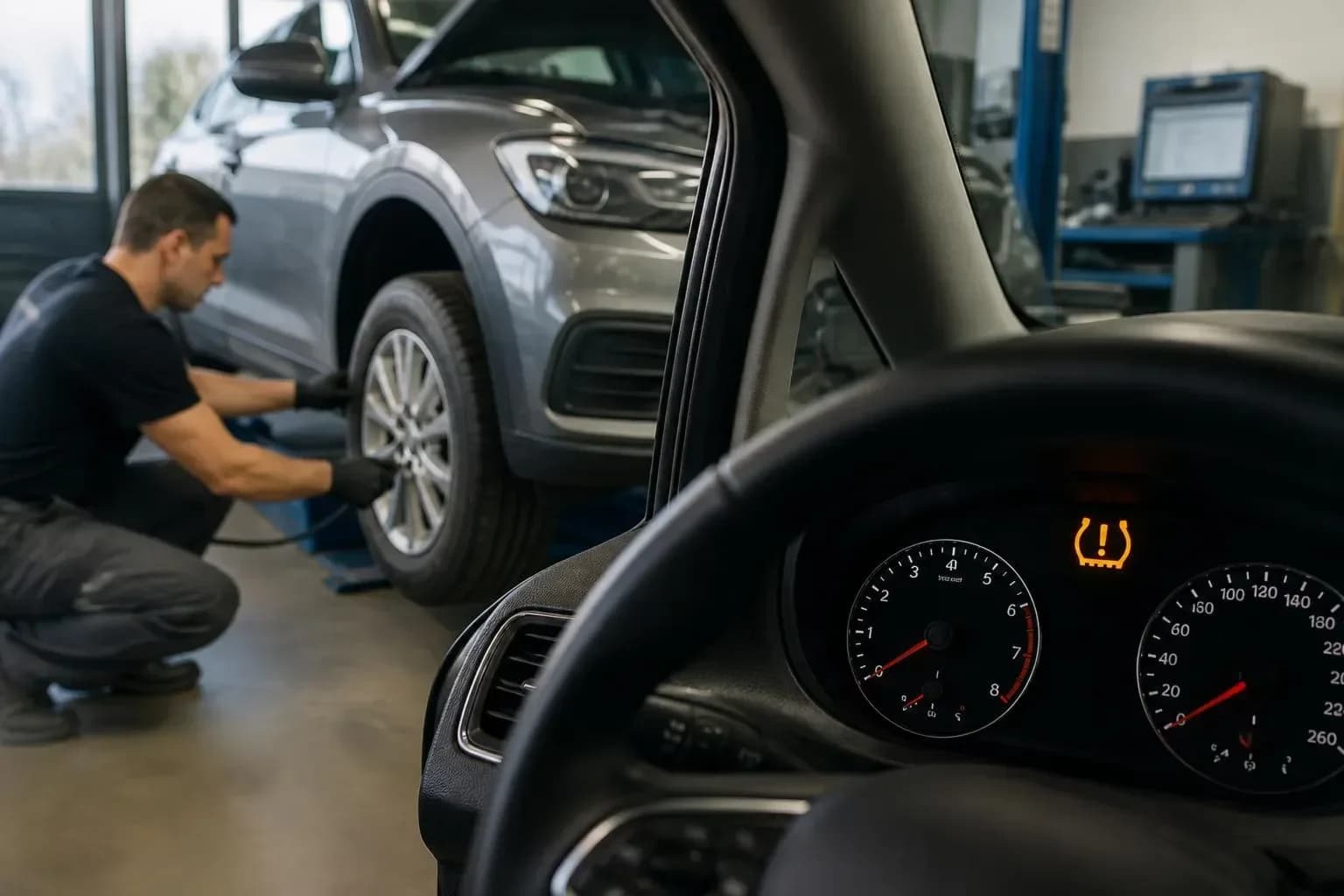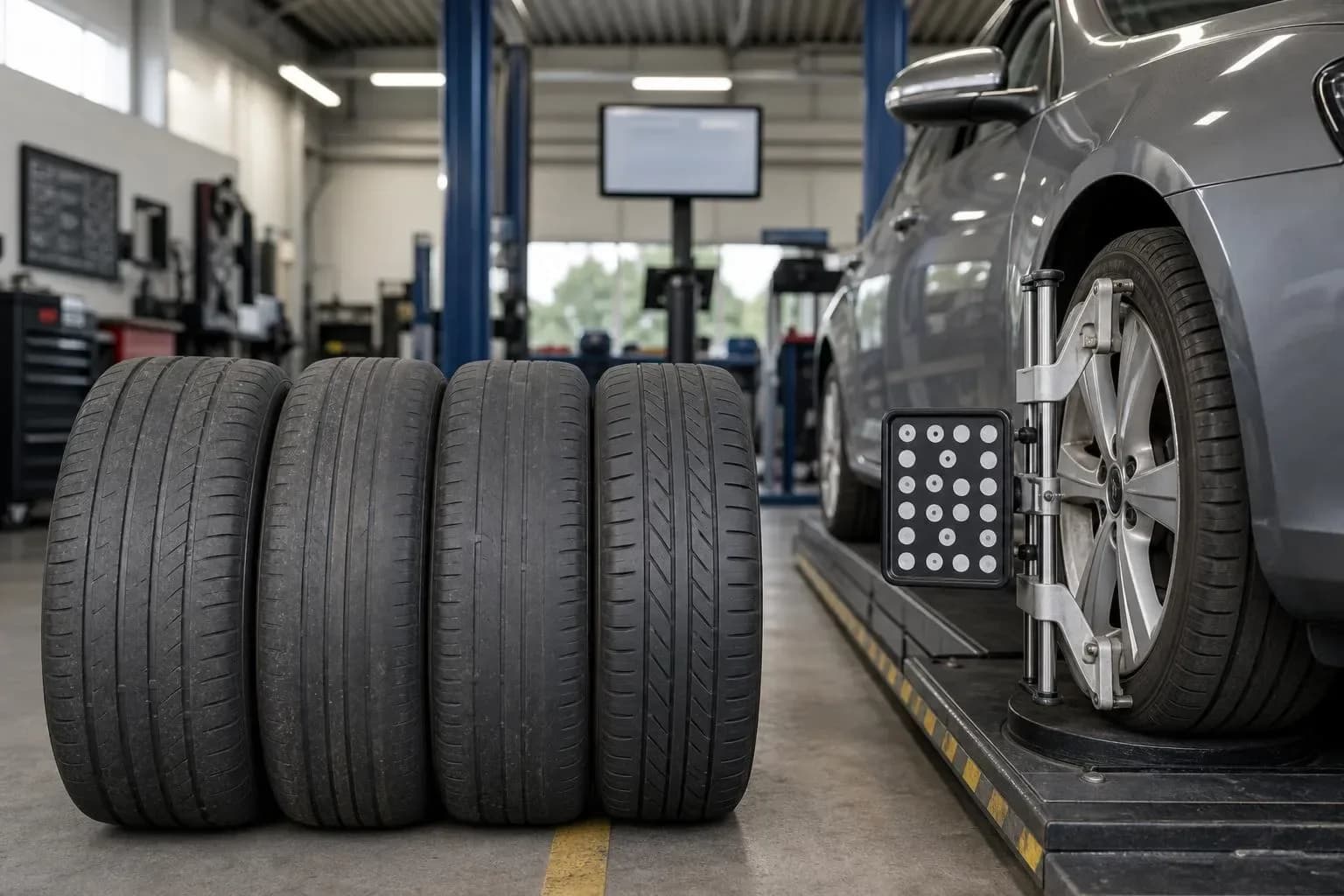
If the car pulls to one side or the tyres wear unevenly, you will usually need a check of the wheel alignment (wheel geometry) and an assessment of the tyres and suspension components. In many cases you can still drive to a check, but sometimes it’s better not to risk it and to drive slowly or stop. Below I explain how to recognise urgency.
What most often causes a car to pull and uneven tyre wear?
The most typical scenario is this: tyres start to act like a “sail” because the wheels are not working parallel to each other. The car then tends to travel slightly sideways, and the driver compensates by holding the steering wheel.
Uneven tyre wear is often a sign that the load on the tread changes on one side. This can be caused by alignment (toe, camber) or by worn suspension parts that cause the settings to shift despite repairs.
In practice we look for the cause in two places: 1) whether the tyre itself is “healthy” (repairs, wear, pressure), 2) whether the wheels are correctly aligned and nothing is pulling them to one side (play in suspension, track rods, control arms, steering components). If the problem returns after changing tyres, alignment or balancing is usually the issue again.
How to tell whether the problem is mainly wheel alignment or the tyres?
A pull on its own does not always mean alignment. Sometimes the tyre is to blame: uneven layer structure, effects of a previous damage, asymmetric wear caused by pressure or one side worn by braking. The key is whether the symptoms follow a repeatable pattern and how the steering wheel behaves.
Did you know that many steering and suspension systems have limited ability to return to the correct setting after an impact? That’s why a small change in geometry after an incident can stop the steering wheel from pointing straight and make the tyres wear unevenly.
- If the steering wheel ‘wants’ to return on its own and the car only tracks straight after you correct the wheel — this often points to alignment, for example wrong toe or camber.
- If you feel clear vibrations at a specific speed — consider wheel balancing or the condition of the tyres, but don’t ignore the alignment.
- If wear is clearly on one side of an axle (e.g. always on the left wheels) — that can indicate incorrect settings on the driven side or play in the suspension.
- If both wheels on one axle wear differently and the differences appear after a change in driving style or tyre pressure — the tyre and pressure may be the main culprit.
- If the problem appears quickly after hitting a kerb, a pothole or after a collision — alignment and suspension parts are the first suspects.
When you can still drive to the service, and when better not to drive?
A simple rule: if the tyres look and behave stably and the car can be controlled without constant steering correction and without worsening vibrations — you can usually drive carefully to have it checked. Urgency increases when you see signs of tyre damage or when the car becomes difficult to control, especially on wet roads.
If in doubt, limit the route to a minimum and drive slower. With poorly behaving tyres the risk of reduced grip in rain and delayed steering response also increases.
- You can drive carefully if: the tread has no cracks or bulges, the tyres maintain contact with the road, and the pull is moderate and does not increase with each kilometre.
- Do not delay (and limit driving) if: wear is clearly one-sided and rapid, you feel increasing steering wheel vibrations, or the car starts to jerk when accelerating or braking.
- Do not risk driving if: the tyre shows a bulge, delamination, a cut with visible damage, exposed cord, or severe cracking of the sidewall.
- If the car simply won’t hold direction on a straight or pulls sharply — treat it as a signal for urgent diagnostics and consider a safe alternative way to get there.
What to check before visiting the service (and what not to miss)?
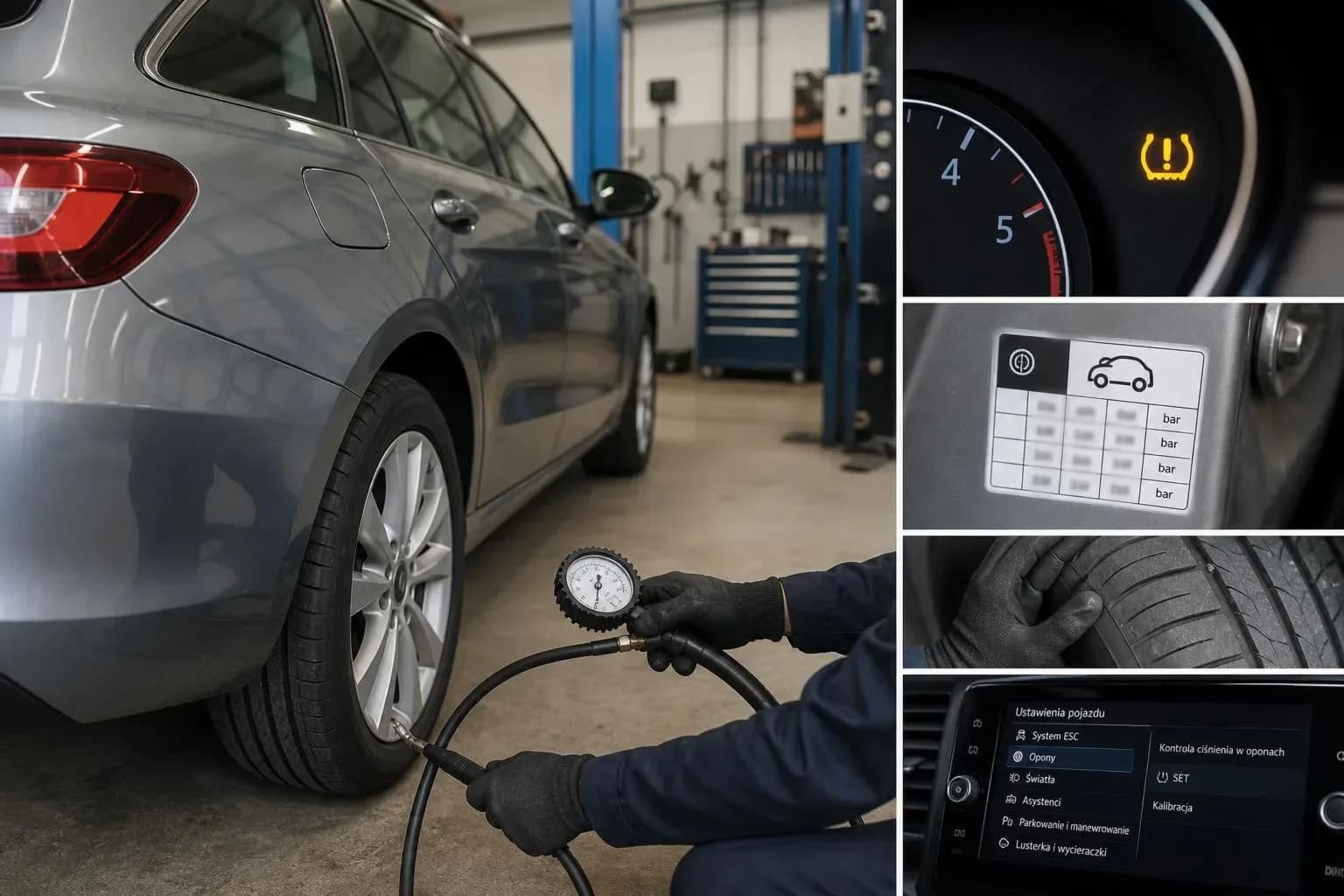
To make diagnostics efficient and not based on guessing, it helps to prepare a few observations. Even a quick home check narrows the focus: do we start with alignment, or with the tyres and pressure?
At the workshop a vehicle mechanic usually combines tyre inspection with wheel alignment measurement and checks for play in the suspension and steering. If the alignment is within limits and symptoms remain clear, other causes come into play: e.g. wheel defects, a tyre problem or imbalance characteristics.
- Tyre pressure — compare left/right and front/rear. Correcting pressure is often the first step if the problem is caused by seasonal fluctuations.
- Tyre appearance — look for sidewall cracks, bulges, uneven wear (inner/outer tread).
- How it pulls — does the car pull after you release the steering on a straight section, or only after a turn?
- Vibrations — does the steering wheel vibrate at a specific speed or after braking, or all the time?
- Signs after incidents — after a pothole, kerb, tyre change or body/repair work, did the problem return or get worse?
What can be the consequences of driving with misaligned wheel geometry?
Driving with incorrect wheel settings is not just about the tread wearing faster. When tyres operate at an angle, rolling resistance and wear of the parts that hold the geometry increase. Additionally, handling becomes less predictable — the driver constantly fights corrections, which is tiring and raises the risk of mistakes in emergency situations.
Therefore, if you see a repeatable pattern and feel a change in handling, get a check before the tyre reaches a very unfavourable level of wear.
- Uneven tyre wear — one side wears out faster even if the other side still looks reasonable.
- Reduced directional stability — the car may need correction on a straight or when the road surface changes.
- Increased risk of vibrations — especially when there is a combination: a worn tyre + wheel vibrations + incorrect settings.
- Rising cost — the longer the problem persists, the more components may eventually need replacing.